


 Brochure - IMS Wf and SC Ultra

G[SAFE] - Tủ Găng Tay An Toàn Cao Cho Chất Độc Hại
Dòng tủ găng tay chuyên dụng làm việc với chất độc hại, bột nguy hiểm hoặc tác nhân gây bệnh. Vận hành dưới áp suất âm và hệ thống lọc kép HEPA đảm bảo an toàn tuyệt đối.
Xem thêmTừ hồ sơ độ sâu tiêu chuẩn đến siêu nông
Điều kiện tiên quyết để phân tích các chất bán dẫn tiên tiến là tối ưu hóa các điều kiện phân tích SIMS để định hình độ sâu siêu nông mà không phải từ bỏ các ứng dụng định hình độ sâu tiêu chuẩn. Do đó, CAMECA đã phát triển một thiết kế thiết bị SIMS độc đáo có khả năng phún xạ các mẫu với dải năng lượng tác động lớn: từ năng lượng cao (phạm vi keV) cho các cấu trúc dày đến Năng lượng cực thấp (≤ 150eV) cho các cấu trúc siêu mỏng. Sự linh hoạt trong lựa chọn năng lượng tác động này có sẵn cho các điều kiện phún xạ được kiểm soát tốt khác nhau (loài, góc tới, v.v...).
CAMECA IMS Wf và SC Ultra là công cụ SIMS duy nhất cung cấp các khả năng Năng lượng Tác động Cực kỳ Thấp (EXLIE) như vậy mà không ảnh hưởng đến độ phân giải khối lượng cao và đường truyền cao.
Khả năng độ tự động hóa cao
Khi kỹ thuật SIMS hoàn thiện, người dùng muốn giảm yêu cầu chuyên môn để đạt được độ lặp lại cao và các phép đo có độ chính xác cao. Xu hướng rõ ràng là hướng tới phân tích tự động, không cần giám sát. CAMECA IMS Wf và SC Ultra đối mặt với thách thức này nhờ tự động hóa máy tính đảm bảo kiểm soát hoàn toàn tất cả các thông số phân tích (công thức phân tích, thiết lập thiết bị, v.v.).
Hệ thống khóa khí, tầng lấy mẫu và buồng phân tích đã được tối ưu hóa để chứa các tấm mỏng lên đến 300 mm (kiểu IMS Wf) và tải một số lượng lớn mẫu trong một lô - lên đến 100 mẫu trong kiểu IMS Wf cũng cung cấp động cơ hoàn toàn chuyển giữa khóa khí và buồng phân tích.
Nhờ mức độ tự động hóa cao, IMS Wf và SC Ultra thực hiện định hình độ sâu sâu nhanh chóng với thông lượng mẫu được tối ưu hóa và độ ổn định tuyệt vời của phép đo, đảm bảo năng suất của công cụ SIMS chưa từng có.
Từ hồ sơ độ sâu tiêu chuẩn đến siêu nông
Điều kiện tiên quyết để phân tích các chất bán dẫn tiên tiến là tối ưu hóa các điều kiện phân tích SIMS để định hình độ sâu siêu nông mà không phải từ bỏ các ứng dụng định hình độ sâu tiêu chuẩn. Do đó, CAMECA đã phát triển một thiết kế thiết bị SIMS độc đáo có khả năng phún xạ các mẫu với dải năng lượng tác động lớn: từ năng lượng cao (phạm vi keV) cho các cấu trúc dày đến Năng lượng cực thấp (≤ 150eV) cho các cấu trúc siêu mỏng. Sự linh hoạt trong lựa chọn năng lượng tác động này có sẵn cho các điều kiện phún xạ được kiểm soát tốt khác nhau (loài, góc tới, v.v...).
CAMECA IMS Wf và SC Ultra là công cụ SIMS duy nhất cung cấp các khả năng Năng lượng Tác động Cực kỳ Thấp (EXLIE) như vậy mà không ảnh hưởng đến độ phân giải khối lượng cao và đường truyền cao.
Khi kỹ thuật SIMS hoàn thiện, người dùng muốn giảm bớt kiến thức chuyên môn cần thiết để đạt được mức độ tự động hóa cao
khả năng tái tạo gh và các phép đo có độ chính xác cao. Xu hướng rõ ràng là hướng tới phân tích tự động, không cần giám sát. CAMECA IMS Wf và SC Ultra đối mặt với thách thức này nhờ tự động hóa máy tính đảm bảo kiểm soát hoàn toàn tất cả các thông số phân tích (công thức phân tích, thiết lập thiết bị, v.v.).
Hệ thống khóa khí, tầng lấy mẫu và buồng phân tích đã được tối ưu hóa để chứa các tấm mỏng lên đến 300 mm (kiểu IMS Wf) và tải một số lượng lớn mẫu trong một lô - lên đến 100 mẫu trong kiểu IMS Wf cũng cung cấp đầy đủ.
Quá trình sản xuất chip bán dẫn mới nhất và việc thu nhỏ hơn nữa các thiết bị CMOS đã đẩy các giới hạn về độ sâu của mối nối xuống dưới phạm vi 10nm, với độ dốc hồ sơ là 1-2nm mỗi thập kỷ. Ở quy mô như vậy, kỹ thuật SIMS có thể được sử dụng để theo dõi sự phân bố sâu của các chất dẫn xuất, chứng minh rằng các cấu hình SIMS có thể được đo với độ phân giải độ sâu tốt hơn 1nm mỗi thập kỷ.
Đạt được độ phân giải độ sâu dưới bước sóng với SIMS năng lượng tác động cực thấp
Những cải tiến gần đây về nguồn ion của SC Ultra và IMS Wf đã cải thiện mật độ chùm tia sơ cấp ở năng lượng tác động rất thấp, do đó cho phép tiếp cận tốc độ phún xạ 1nm/phút cho cả Cs+ và O2+ @ 150eV. Một loạt các năng lượng tác động ion sơ cấp có thể tiếp cận cho phép chọn các điều kiện phân tích thích hợp để có được sự phân bố nồng độ sâu thực sự. Dải động cao trong mọi cấu hình là yếu tố chính để đo lường độ chính xác cao.
Một trong những ưu điểm chính của công thức EXLIE là kết hợp độ phân giải độ sâu dưới nm với định lượng gần bề mặt chính xác, mang lại sự phân bố các loài tạp chất được cấy ghép thực sự.
Hình trên là các cấu hình cấy ghép năng lượng thấp cho thấy sự phân bố thực trong 10nm đầu tiên. Như: 250eV - P: 200eV - B: 100eV.

This webinar presented by Paweł Michałowski from Łukasiewicz - IMiF, is only available on demand. Please fill in the contact form under CONTACT -> CONTACT US to request the link.
Click here to view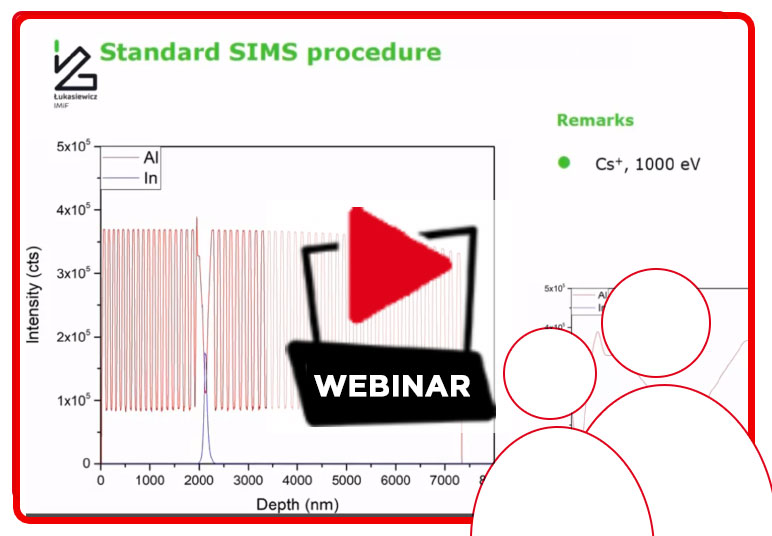
A review of a broad array of IC applications with Dynamic SIMS, from deep to ultra-shallow implant depth profiling in Si-based semiconductors to compositional analysis of thin multilayers in patterned wafer pads, optoelectronics, 2D and non-planar 3D structures. Speaker: Pawel Michałowski, expert-user of CAMECA SC Ultra SIMS at Łukasiewicz Research Network – Institute of Microelectronics and Photonics, Poland
↓ Duration : 20 minutes
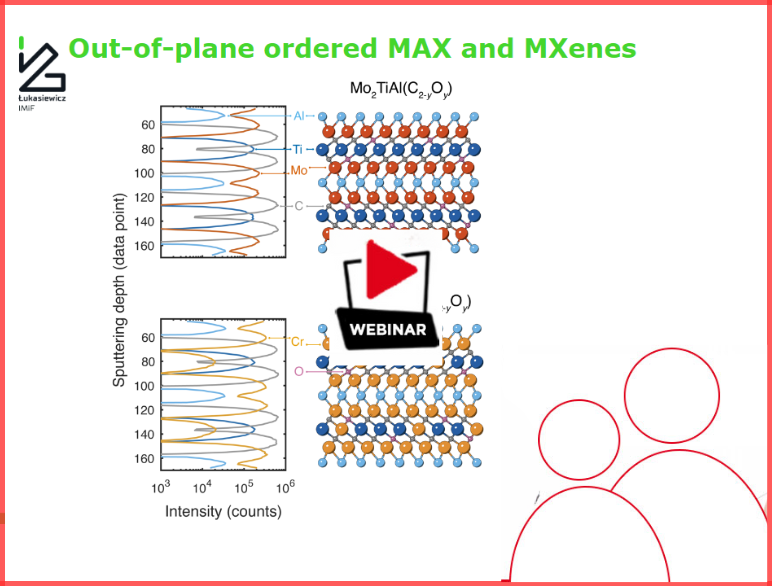
Learn with Dr. Paweł P. Michałowski why novel ultrathin 2D materials are so attractive for applications ranging from energy storage to electronics and medicine, how compositional variability and the interaction of surface termination layers affect fine-tuning of MAX and MAXenes properties and how ultra-low energy Secondary Ion Mass Spectrometry can facilitate further development of MAX and MXenes.
↓ Duration: 48 minutes
A PDF spreadsheet compiling scientific research articles using IMS Wf & SC Ultra data is available for download.
Click here to download
You are welcome to send us any missing references, pdf and supplements!
Please email cameca.info@ametek.com
Solid-phase epitaxial regrowth of phosphorus-doped silicon by nanosecond laser annealing. S. Kerdil`es, M. Opprecht, D. Bosch, M. Ribotta, B. Skl´enard, L. Brunet, P.P. Michalowski. Materials Science in Semiconductor Processing Volume 186, February (2025), 109043.
Read the full article
Ultralow impact energy dynamic secondary ion mass spectrometry with nonfully oxidizing surface conditions. A. Merkulov. J. Vac. Sci. Technol. B 42, 064005 (2025)
Fabrication and Characterization of Boron‑Implanted Silicon Superconducting Thin Films on SOI Substrates for Low‑Temperature Detectors. A. Aliane · L. Dussopt · S. Kerdilès · H. Kaya · P. Acosta‑Alba · N. Bernier ·A.‑M. Papon · E. Martinez · M. Veillerot · F. Lefloch. Journal of Low Temperature Physics (2024)
Read the full article
MXenes with ordered triatomic-layer borate polyanion terminations. Dongqi Li, Wenhao Zheng, Sai Manoj Gali, Kamil Sobczak, Michal Horák, Josef Polčá, Nikolaj Lopatik, Zichao Li, Jiaxu Zhang, Davood Sabaghi, Shengqiang Zhou, Paweł P. Michałowski, Ehrenfried Zschech, Eike Brunner, Mikołaj Donten, Tomáš Šikola, Mischa Bonn, Hai I. Wang, David Beljonne, Minghao Yu, Xinliang Feng. ChemRxiv (2024)
Read the full article
Deep-level defects induced by implantations of Si and Mg ions into undoped epitaxial GaN. Paweł Kamiński, Andrzej Turos, Roman Kozłowski, Kamila Stefańska-Skrobas, Jarosław Żelazko, and Ewa Grzanka. Sci Rep. (2024); 14: 14272
Read the full article
Fabrication and Performance Evaluation of a Nanostructured ZnO-Based Solid-State Electrochromic Device. Marivone Gusatti, Daniel Aragão Ribeiro de Souza, Mario Barozzi, Rossana Dell’Anna, Elena Missale, Lia Vanzetti, Massimo Bersani, and Marcelo Nalin. ACS Appl. Mater. Interfaces (2024)
Read the full article
Advanced SiGe: B Raised Sources and Drains for p-type FD-SOI MOSFETs. Jean-Michel Hartmann, Francois Aussenac, Olivier Glorieux, David Cooper, Sebastien Kerdilès, Zdenek Chalupa, Francois Boulard, Heimanu Niebojewski, Blandine Duriez, Thomas Bordignon, Sebastien Peru, Pawel Michałowski, Richard Daubriac, Fuccio Cristiano. ECS Transactions 114(2),185 (2024)
Read the full article
Secondary ion mass spectrometry quantification of boron distribution in an array of silicon nanowires. Paweł Piotr Michałowski, Jonas Müller, Chiara Rossi, Alexander Burenkov, Eberhard Bär, Guilhem Larrieu, Peter Pichler. Measurement 211, 112630 (2023)
Read the full article
Oxycarbide MXenes and MAX phases identification using monoatomic layer-by-layer analysis with ultralow-energy secondary-ion mass spectrometry. Paweł Piotr Michałowski, Mark Anayee, Tyler S Mathis, Sylwia Kozdra, Adrianna Wójcik, Kanit Hantanasirisakul, Iwona Jóźwik, Anna Piątkowska, Małgorzata Możdżonek, Agnieszka Malinowska, Ryszard Diduszko, Edyta Wierzbicka, Yury Gogotsi. Nature Nanotechnology 17, 1192-1197 (2022)
Read the full article
Titanium pre-sputtering for an enhanced secondary ion mass spectrometry analysis of atmospheric gas elements. Paweł Piotr Michałowski. Journal of Analytical Atomic Spectrometry 35, 1047 (2020).
Read the full article
Growth and thermal annealing for acceptor activation of p-type (Al)GaN epitaxial structures: Technological challenges and risks. Sebastian Złotnik, Jakub Sitek, Krzysztof Rosiński, Paweł Piotr Michałowski, Jarosław Gaca, Marek Wójcik, Mariusz Rudziński. Applied Surface Science 488, 688-695 (2019).
Read the full article
Sodium enhances indium-gallium interdiffusion in copper indium gallium diselenide photovoltaic absorbers. D. Colombara, F. Werner, T. Schwarz, I. Cañero Infante, Y. Fleming, N. Valle, C. Spindler, E. Vacchieri, G. Rey, M. Guennou, M. Bouttemy, A. Garzón Manjón, I. Peral Alonso, M. Melchiorre, B. El Adib, B. Gault, D. Raabe, Phillip J. Dale & S. Siebentritt. Nature Communications volume 9, Article number: 826 (2018).
Read full article
Reproducibility of implanted dosage measurement with CAMECA Wf. Kian Kok Ong, Yun Wang and Zhiqiang Mo. IEEE 24th International Symposium on the Physical and Failure Analysis of Integrated Circuits (2017).
Read the full article
Secondary ion mass spectroscopy depth profiling of hydrogen-intercalated graphene on SiC. Pawel Piotr Michalowski, Wawrzyniec Kaszub, Alexandre Merkulov and Wlodek Strupinski. Appl. Phys. Lett. 109, 011904 (2016).
Read the full article
SIMS depth profiling and topography studies of repetitive III–V trenches under low energy oxygen ion beam sputtering. Viktoriia Gorbenko, Franck Bassani, Alexandre Merkulov, Thierry Baron, Mickael Martin, Sylvain David and Jean-Paul Barnes. J. Vac. Sci. Technol. B 34, 03H131 (2016).
Read the full article
Ion beam characterizations of plasma immersion ion implants for advanced nanoelectronic applications. M. Veillerot, F. Mazen, N. Payen, J.P. Barnes, F. Pierre (2014), SIMS Europe 2014, September 7-9, 2014.
Influence of Temperature on Oxidation Mechanisms of Fiber-Textured AlTiTaN Coatings. V. Khetan, N. Valle, D. Duday, C. Michotte, M-P Delplancke-Ogletree, and P. Choquet. ACS Appl. Mater. Interfaces (2014), 6, 6, 4115–4125.
Read the full article
Ag-Organic Layered Samples for Optoelectronic Applications: Interface Width and Roughening Using a 500 eV Cs+ Probe in Dynamic Secondary Ion Mass Spectrometry. P. Philipp, Quyen K. Ngo, M. Shtein, J. Kieffer, and T. Wirtz. Anal. Chem. 2013, 85, 1, 381–388.
Read the full article
Sputtering behavior and evolution of depth resolution upon low energy ion irradiation of GaAs. M.J.P. Hopstaken, M.S. Gordon, D. Pfeiffer, D.K. Sadana, T. Topuria, P.M. Rice, C. Gerl, M. Richter, C. Marchiori. Journal of Vacuum Science & Technology B: Microelectronics and Nanometer Structures. Volume 28, Issue 6, 1287, 18 November 2010
Advanced SIMS quantification in the first few nm of B, P, and As Ultra Shallow Implants. A.Merkulov, P.Peres, J.Choi, F.Horreard, H-U.Ehrke, N. Loibl, M.Schuhmacher, Journal of Vacuum Science & Technology B. 28, C1C48 (2010) ; doi:10.1116/1.3225588
Depth profiling of ultra-thin oxynitride date dielectrics by using MCs2+ technique. D.Gui, Z.X.Xing, Y.H.Huang, Z.Q.Mo, Y.N.Hua, S.P.Zhao and L.Z.Cha (2008), App. Surf. Science, Volume 255, Issue 4, Pages 1437-1439. doi:10.1016/j.apsusc.2008.06.047.
Short-term and long-term RSF repeatability for CAMECA SC Ultra SIMS measurements. M. Barozzi, D. Giubertoni, M. Anderle and M. Bersani. App. Surf. Science 231-232 (2004) 768-771
Toward accurate in-depth profiling of As and P ultra-shallow implants by SIMS. A. Merkulov, E. de Chambost, M. Schuhmacher and P. Peres. Oral presentation at SIMS XIV, San Diego, USA, Sep. 2003. Applied Surface Science 231–232 (2004) 640–644
Latest developments for the CAMECA ULE-SIMS instruments: IMS Wf and SC Ultra. E. de Chambost, A. Merkulov, P. Peres, B. Rasser, M. Schuhmacher. Poster for SIMS XIV, San Diego, USA, Sept 2003. Applied Surface Science 231–232 (2004) 949–953
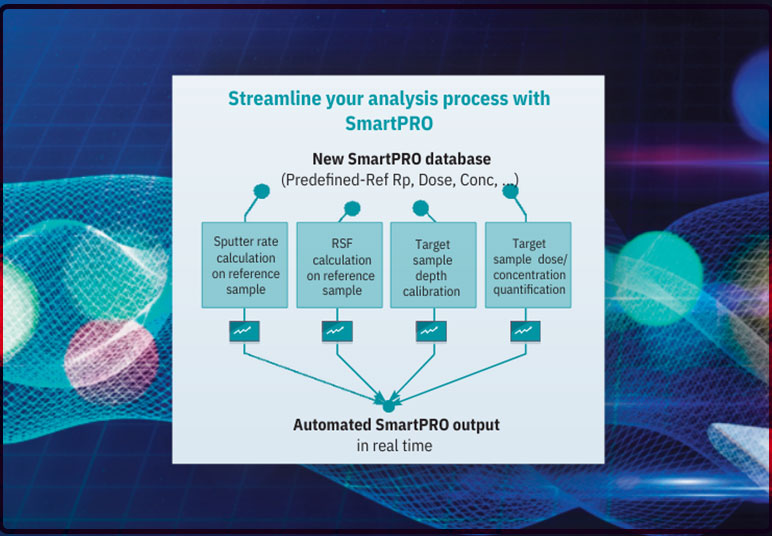
The new SmartPRO software package for CAMECA IMS 7f-Auto, IMS Wf and SC Ultra Secondary Ion Mass Spectrometers combines Chain Analysis and WinCurve in a seamlessly integrated environment and adds real time data processing and...

Specifically developed for CAMECA SIMS instruments, WinCurve offers powerful data processing & visualization capabilities in a user-friendly environment.

Specifically developed for CAMECA SIMS instruments, WinImage II offers powerful image visualization, processing & printing capabilities under PC-Windows™ Environment.
Automation & Software
PC-Automation (Wf/SCU)
PC-Automation system to replace SUN system, allows full automation & unattended operation and greatly improves ease of use.
Please note that most of the upgrade kits listed below can only be installed on IMS Wf and SC Ultra instruments equipped with PC-Automation.
Post-treatment (Wf/SCU)
PC station for off-line data treatement (CAMECA software not included).
Desk control duplication (Wf/SCU)
Additional PC, keyboard, CAMECA keypad, screens... ensuring optimized operation comfort when the lab is split in two parts.
WinCurve software (Wf/SCU)
Offers powerful SIMS data processing & graphing capabilities together with easy report creation functionalities.
WinImage Software (Wf/SCU)
Offers powerful SIMS image processing functions, available in Standard or Extended version.
Remote monitoring (Wf/SCU)
Real Time Display software licence providing remote access to all instrumental parameters, thus allowing the operator to remotely tune and run the instrument from his/her own PC.
Sources
Low energy cesium ion source (Wf/SCU)
With this new high brightness cesium ion source, the IMS Wf/SCU can now perform Extremely Low Impact Depth Profiling and analyse ultra thin layers with nanometer depth resolution.
High brightness RF plasma oxygen ion source (Wf/SCU)
Compared to conventional DUO-plasmatron, the RF plasma source allows substantial performance improvements using ultra low energy O2 primary beam.
Specimen Chamber
Motorized Z-movement stage (Wf/SCU)
Replaces the piezo-stage movement
Turbo Detection (Wf/SCU)
Turbomolecular pump to replace the existing ionic pump. Improves vacuum in the detection system.
CÁM ƠN BẠN ĐÃ GHÉ THĂM WEBSITE MỚI CỦA CHÚNG TÔI!