Introduction to IRMS

The measurement of ion beam intensities with sufficient precision to determine isotope natural abundances requires purpose-built IRMS. The basic IRMS design has changed little since it was first developed. Only major developments in materials, electronics, and data handling distinguish modern automated IRMS from their predecessors. An IRMS for low atomic weight elements can analyze only low molecular weight ‘‘fixed gases,’’ irrespective of the nature of the original sample. H2 is used for D/H measurement, N2 for 15N/14N, CO2 for both 13C/12C and 18O/16O, and SO2 or SF6 for 34S/32S. The gas is admitted to the mass spectrometer from a reservoir through a fine capillary. This gives a steady supply of gas to the ion source and avoids diffusive fractionation of the isotopes  in the inlet. In the source, the gas is ionized by an electron beam produced from a hot filament of rhenium or thoriated tungsten. The ion stream is accelerated through 3–5 kV before entering a  magnetic sector mass analyzer. The ion beam passes through a magnetic field at 90 to its direction of travel. This causes the beam to bend. Ions of different m/z leave the source with equal velocity, but the heaviest have most momentum and are deflected less easily by the magnetic field.

Sample introduction methods 
Samples are introduced to the ion source as pure gas (dual inlet - DI) or carried on a flow of helium carrier gas (continuous flow - CF). A range of preparation systems are available to convert solid, liquid and gas samples containing stable isotopes into a gas that can be analyzed, while preserving the isotopic signature of the original sample. The light elements, their stable isotopes and the gases used for analysis are listed in the table below:

IRMS Introduction table


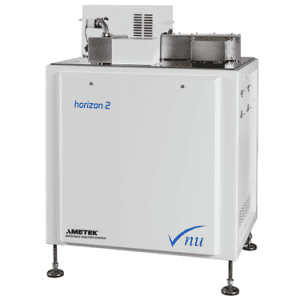
The Nu Instruments Horizon 2 IRMS instrument is designed for flexibility, reliability and high performance, with user friendly instrument control and data analysis software. This next generation instrument possesses unique features for both Dual Inlet (DI) and Continuous Flow (CF) analysis, interfacing with a wide range of sample preparation peripherals.
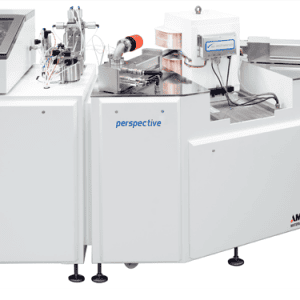
The Nu Instruments Perspective is designed for flexibility, high performance and reliability, it has the ability to achieve precise measurements from the smallest sample. The Perspective with its standard collector block sets a new benchmark in performance for routine stable isotope ratio applications for the measurement of carbon, nitrogen, oxygen, sulphur and hydrogen. 
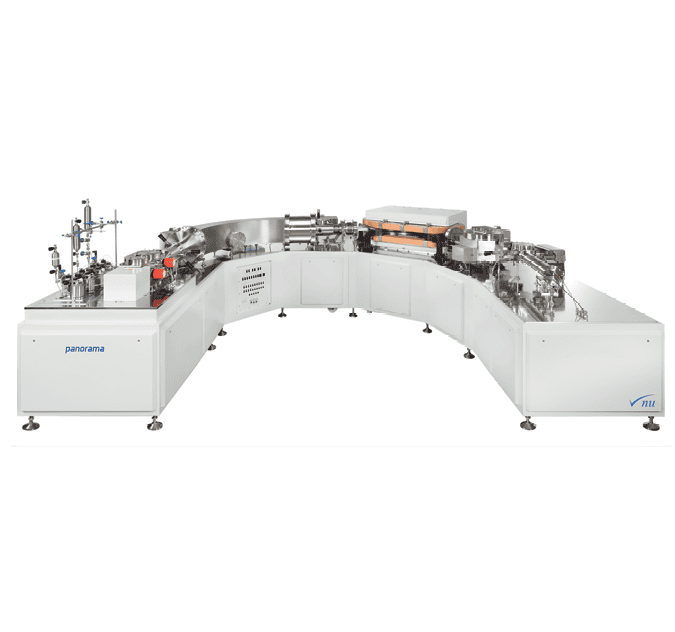
The Panorama is an entirely new ultra-high resolution multiple collector mass spectrometer specifically designed to undertake stable isotope analyses, far exceeding the performance of other commercial instruments.


The application of Stable Isotopes measurements can be used to integrate, indicate, record and trace fundamental ecological processes. Rapid technological advances over the past decade have greatly stimulated the use of isotope analyses by ecologists. This analytical approach is now among the most popular in ecology because of the insights provided by isotope ratios at natural abundance levels.

Geosciences | Free Full-Text | Geochronology and Stable Isotope Analysis of Fracture-Fill and Karst Mineralization Reveal Sub-Surface Paleo-Fluid Flow and Microbial Activity of the COSC-1 Borehole, Scandinavian CaledonidesIsotopes integrate ecological processes in space and time. The isotope ratios of plant and animal tissues and organic and inorganic compounds (including gases) in soil represent a temporal integration of significant physiological and ecological processes on the landscape. The timescale of this integration depends on the element turnover rate of the tissue or pool in question. In addition, the isotope ratios of well-mixed environmental reservoirs, such as the atmosphere, streams and aquifers, often represent an integration of source inputs to the system that extend over large spatial scales.  
Isotopes indicate the presence and magnitude of key ecological processes. Many ecological processes produce a distinctive isotope fingerprint. The presence or absence of such processes and even their magnitude in relation to other processes are indicated by the stable isotope ratio value relative to known background values.   
Isotopes record biological responses to Earth’s changing environmental condition. For cases in which substances or residues accumulate in an incremental fashion, such as in tree rings, animal hair and ice cores, isotope ratios can be used as a record of system response to changing environmental conditions or a proxy record for environmental change.  
Isotopes trace the origin and movement of key elements and substances. Owing to isotopic fractionations associated with physical and biological reactions, nutrient and element pools within and among ecosystems often differ isotopically. As a result, the source(s) of essential elements and resources acquired by an organism are easily traced using isotope ratios. Strong geographic patterns in isotope signature variation provide the means to trace the movement or origin of a substance or component at landscape to continental scales.

  • Chia sẻ qua viber bài: Introduction to IRMS
  • Chia sẻ qua reddit bài:Introduction to IRMS

PRODUCTS

Loading...

RELATED PRODUCTS

IQM Resonance – Quantum Cloud Platform

IQM Resonance – Quantum Cloud Platform Supplier: IQM – Finland IQM Resonance is a fully managed cloud-based quantum computing platform that provides instant access to advanced Quantum Processing Units (QPUs), ideal for enterprises, research institutes, and academic environments.
Xem thêm

IQM Radiance 20, 54 and 150 Qubits quantum computer

IQM Radiance 20, 54 and 150 Qubits quantum computer Model: IQM Radiance Manufacturer: IQM Quantum Computers - Finland Origin: Finland IQM Radiance is an advanced superconducting quantum computing platform designed for high-performance computing (HPC) centers, data centers, government agencies, and enterprises seeking to harness quantum advantage. With high-quality qubits and hybrid integration, Radiance is an ideal solution for practical applications in machine learning, cybersecurity, energy optimization, and chemical research.
Xem thêm

IQM Spark 5-qubit quantum computer

IQM Spark 5-qubit quantum computer Model: IQM Spark Manufacturer: IQM Quantum Computers – Finland Origin: Finland IQM Spark is a superconducting quantum computer system specifically designed for universities, research institutes, and laboratories to support education, quantum algorithm development, and research in the NISQ (Noisy Intermediate-Scale Quantum) era. With a cost-effective approach, this system offers high performance, flexible integration, and an optimized design for quantum research applications.
Xem thêm

LD250 Dilution Refrigerator Measurement System

LD250 Dilution Refrigerator Measurement System Model: LD250 Manufacturer: Bluefors - Finland Origin: Finland Designed to provide an ultra-low temperature environment (below 10 mK) for quantum experiments and low-temperature physics research, the LD250 system stands out with its rapid cooling capability, automated operation, and open design for easy access to the experimental space. It is optimized to deliver high cooling power, making it suitable for experiments requiring large sample spaces and robust cooling performance.  
Xem thêm