X-ray diffraction (XRD) is used to study the crystal structure of materials because the wavelength of X-rays (from 0.2 to 10 nm) is quite similar to the distance between atoms of crystalline solids. This technique measures the average distance between layers or rows of atoms. XRD allows us to determine the orientation of a single crystal or grain and measure the size and shape of small crystalline regions.
In XRD, an X-ray beam passes through a diverging slit and is incident on the sample surface. The X-ray beams incident on the sample are scattered back by the periodic crystal lattice, causing interference and X-ray diffraction. We will obtain an X-ray diffraction spectrum (peak or peak of constructive interference) if the X-ray beam incident on the sample surface satisfies BRAGG's law: 2dSinƟ = nλ.
In there:
d: is the distance between two consecutive atomic layers
Ɵ: Incident angle of X-ray beam relative to atomic layer
n: order of diffraction
λ : X-ray wavelength
With the wavelength λ being a known constant, by changing the angle of the X-ray incident on the atomic layer until a diffraction spectrum is obtained, we will calculate the coefficient d; the crystal lattice numbers h, k, l, comparing with the International Center for Diffraction Data (ICDD) we will determine the crystal lattice structure; phase structure; identify and quantify the phase composition; calculate the size and crystallinity of the crystal, ...
The application of X-ray diffraction has many specific techniques, including some methods such as
- X-ray diffraction method of powder materials
Power X-ray diffraction
- used with polycrystalline samples, the most widely used method for determining crystal structure, by shining a narrow, monochromatic, parallel beam of X-rays on the sample. The sample and the diffraction detector are rotated in concentric circles, the reflected beam intensity is recorded, and the first-order diffraction spectrum (n = 1) is recorded.
- The diffraction spectrum will be the dependence of the diffraction intensity on 2 times the diffraction angle (2θ). For thin film samples, the method is a little different, people irradiate X-rays at a very narrow angle (to increase the length of X-rays interacting with the thin film), keep the sample fixed and only rotate the receiver.
- Powder diffraction method allows to determine phase composition, phase fraction, crystal structure (lattice parameters) and is very easy to perform...
- Laue method
- Single crystal rotation method
Structure of X-ray diffraction spectrometer
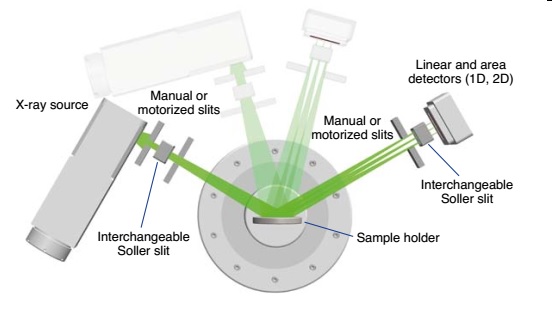
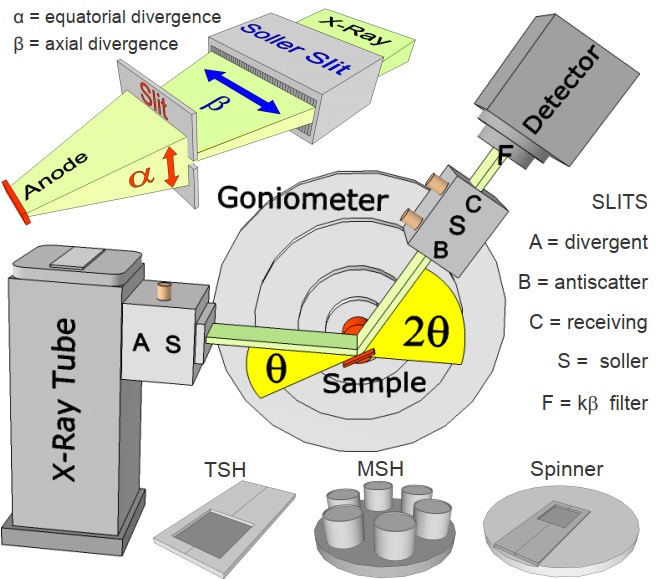
The X-ray diffraction spectrometers we are learning about here are Powder X-Ray Diffraction (PXRD) machines. There are many types of machines such as: Desktop type; Floor type; Mobile type, but basically they all include the following main parts:
 |  |
Theta Type - Theta | Theta Type – 2 Theta |
- X-ray source (X-ray source/X-ray tube/X-ray generator): with various capacities from 300W to 4kW; Voltage from 30kV to 80kV; Current from 10mA to 80mA suitable for many applications, with many different types of samples
- Soller divergence slit: X-ray direction from the source to the sample surface to be analyzed
- Sample holder: can hold 1 sample or a rotating tray to hold multiple samples; there are many types depending on the shape and size of the sample
- Goniometer:
+ There is Theta type – Theta: Fixed sample; X-ray source and Signal receiver move to ensure the incident angle and reflection angle are always equal (and equal to Ɵ).
+ Or Theta – 2 Theta type: Fixed X-ray source, Sample holder and Signal receiver move to ensure the reflection angle (2Ɵ) is 2 times the incidence angle (Ɵ).
+ Goniometer has the largest scanning angle range from -110 0 to +168 0 ; the smallest angle step is 0.0001 0
- Soller slot collects reflected X-rays: Directs the reflected X-rays from the sample surface into the signal receiver
- Detector: can be Scintillation counter Nal or more advanced CeleriX 1D Hybrid Photon Counting (HPC) microstrip to collect X-ray diffraction spectrum; can install SDD detector to quantitatively analyze the chemical elements in the sample.
- Computer with software for controlling, analyzing and processing diffraction data
- Chiller for circulating cooling of X-ray source
Applications of X-ray diffraction spectrometer
X-ray diffraction is a complex technique, XRD can be used to identify single crystals and reveal their structure, and geologists find XRD particularly useful because it can be used to identify crystals in mixtures, such as minerals in rocks. For minerals with variable formulas and structures, such as clays, XRD is the best method for identifying and determining their proportions in a sample and for materials research applications such as the identification of minerals, inorganic compounds. Identifying unknown solids is extremely important for studies in geology, environmental science, materials science, engineering and biology, these applications include:
- Study of crystal lattice structure; calculation of crystal size and crystallinity
- Qualitative phase structure and quantitative phase composition of materials
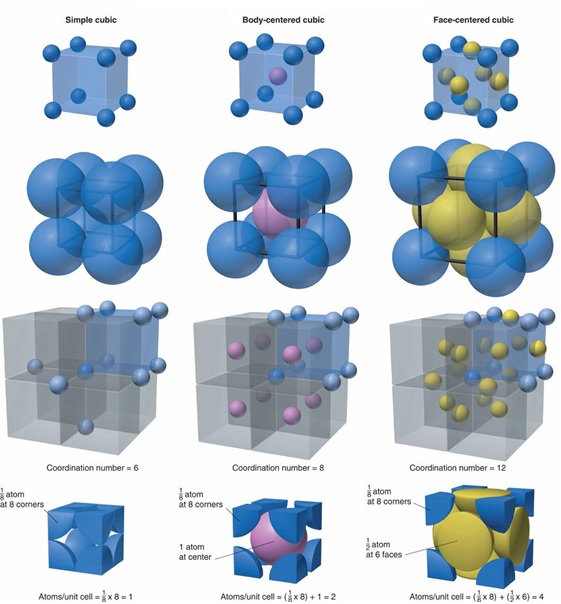
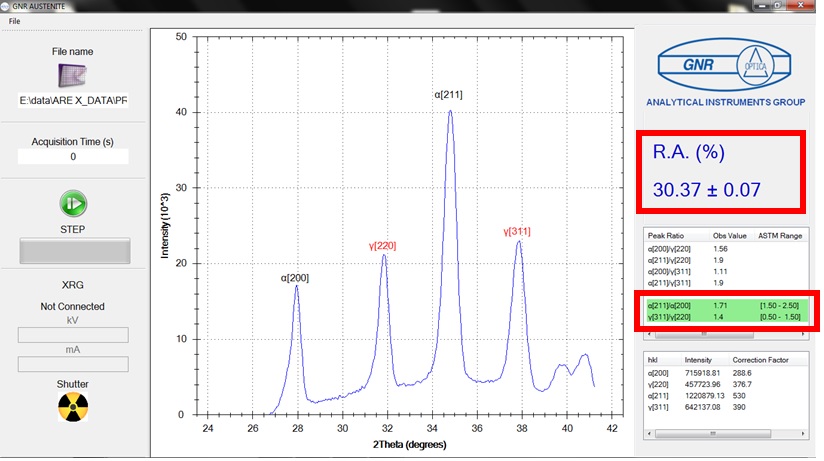
- Analysis of residual austenite content of phase transformation after heat treatment
- Residual stress analysis, crystal lattice deformation
- Determination of crystalline properties of materials
- Determination of crystal structure using Rietveld Analysis
- Perform measurements of material structure, such as grain orientation in polycrystalline samples
- Measure sample purity
- Determination of the composition and content of minerals (quantitative analysis)
- Determination of fine-grained minerals such as clays and mixed clays (which are difficult to determine by optical methods)
- Determine the unit size of the crystal lattice
Due to the applications of XRD, X-ray diffraction has some advantages and limitations such as:
Advantage
Get fast results (<20 minutes) to identify an unknown mineral.
Provides quantitative mineral information in most cases.
Minimal sample preparation.
XRD equipment is relatively common and moderately priced.
Interpreting the data is relatively simple.
Limit
Homogeneous material is required when unknown materials are to be identified.
Need standard reference library of inorganic compounds.
Sample requirement is 0.1 gram of powdered material.
For mixed materials, the detection limit is ~ 2% of the sample.
For the application of crystal unit cell determination, indexing patterns for non-isometric crystal systems is complex.
Surface resonance can occur due to the influence of “reflected” signals at high angles.


