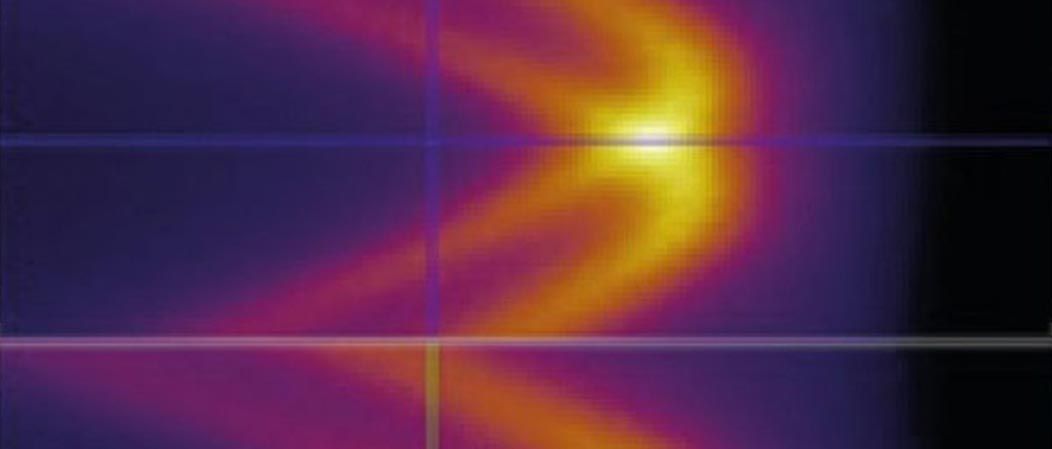
Photoelectron spectroscopy (PES) is one of the most powerful and most frequently used spectroscopic techniques in solid state physics, physical chemistry, and materials science. Using the photoelectric effect, PES provides a material-sensitive and non-destructive probe for modern scientists to examine the chemical composition (XPS or ESCA) and the electronic structure (UPS and ARPES) of materials. By illuminating a sample with light of a certain photon energy (hν), electrons are released from a solid using the photon energy to overcome their binding energy (Eb) and work function (Φ). The remaining energy provided by the photons is transformed into the kinetic energy (Ekin) of the photoelectrons. Such a transition can only occur from occupied electronic states of an energy Ei into unoccupied states of energy Ef because of the energy conservation rule.
Ekin=hv-Eb-∅
In the special case of UPS and ARPES, only electrons of the topmost electronic states, close to Fermi level, are in the focus of the analysis. Those electrons form the conduction band (valence bands and surface states) in the case of metals and semiconductors and are of special interest for modern materials science. Their wave vector (or momentum) k ( kx, ky, kz), and the energy has to be conserved during the photoemission process. This leads to different characteristic emission angles of the electron from the surface, depending on their momentum inside the material. As a result, it is possible to record the photoemission intensity (I) as a function of the kinetic energy (Ekin), providing the chemical/energy information, and the emission angle, providing the momentum (k) of the electrons.

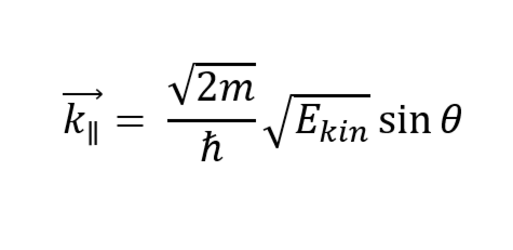
The surface breaks the geometry, not affecting the energy conservation rule, but affecting the momentum conservation such that the parallel wave component kӀӀ (meaning kx and ky) is conserved after crossing the surface whereas the component along the surface normal (k┴) is not conserved. The electrons can be analyzed in an electron analyzer with respect to their Ekin (or recalculated to Eb) and to Θ (or recalculated to the parallel wave vector component (kӀӀ). On this basis, a 2D distribution of the electrons for given Ekin and kӀӀ is measured, directly reflecting the electronic (or band) structure of the material.
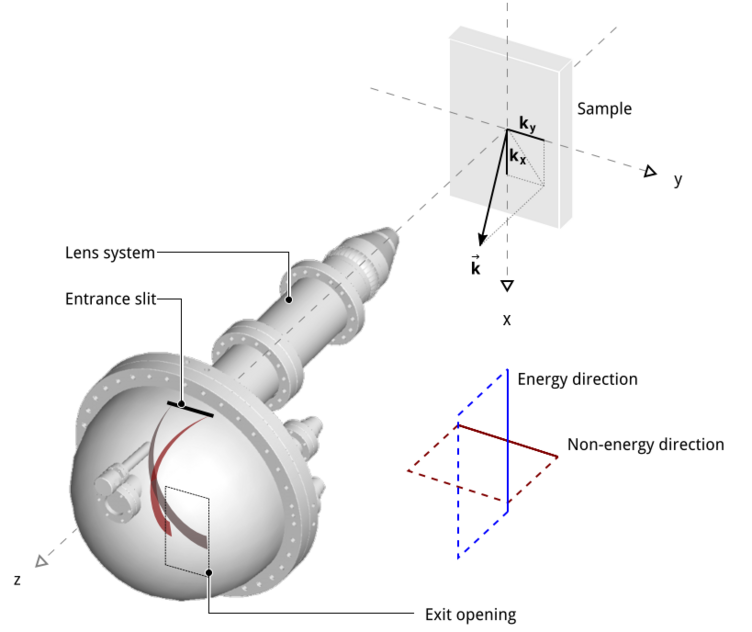
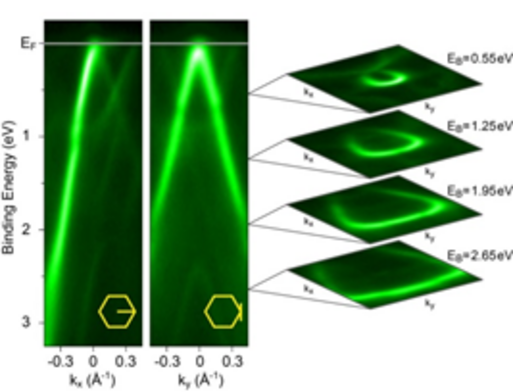
Modern analyzers and surface analysis systems offer the possibility to access a second emission angle by tilting the sample along the y-axis or by using an integrated mapping deflector inside the electron lens (for example the SPECS ASTRAIOS 190). By shifting the emission angle in the second dimension, it is possible to acquire a two dimensional band map in the dimensions kx and ky. The out-of-plane momentum kz, can be accessed by changing the photon energy of the excitation light source.
Such experiments in laboratory environments require intense, small spot UV light sources of high stability for optimum performance. The intensity of the light source is the key point for fast and efficient measurements while small spot sizes ensure measurements with highest angle (or momentum) resolution. SPECS offers a series of UV sources fitted for various demands, starting from flexible and robust UV sources for economic application to highly sophisticated UV sources for different gases and photon energies with monochromators for highest performance and energy resolution.
In addition to the energy and the momentum, further dimensions can be taken into account for scientific analysis such as the spin of an electron or even the real space origin for small spot analysis (see momentum microscopy). Using a spin sensitive detection unit, it is possible to measure the intensity difference between the electrons of majority and minority spin (spin up and down) and calculate the so called asymmetry function.
For the interested reader: It is good to know that in ARPES (and in photoemission in general) the collected electrons originate from an excited state. However, in most cases it is a good approximation to assume the final state is similar enough to the ground state to make conclusions about the electronic structure of a solid.


