


Jacomex G[SAFE] - High Security Glove Box for Hazardous Materials
Specialized glove box for handling toxic substances, hazardous powders, or pathogens. Operates under negative pressure with dual HEPA filtration for total safety.
Xem thêmSurface sensitive spectroscopic methods, like Auger Electron Spectroscopy (AES), Low Energy Ion Scattering Spectroscopy (LEISS) and especially X-ray or UV excited Photoelectron Spectroscopy (XPS and UPS) became powerful tools to characterize the surface chemical composition, the chemical state of the surface electrons and the electronic properties of materials surfaces.
Modern related methods can give insight into the surface chemical structure, (Scanning Auger Microscopy (SAM), XPS chemical mapping or X-ray Photoelectron Diffraction (XPD)), or in the complete electronic and magnetic structure (Angle Resolved or Spin Resolved Photoelectron Spectroscopy (ARPES or Spin-PES).
Since about 10 years it is also possible to perform some of these spectroscopic methods also under environmental or Near Ambient Pressure (NAP) conditions, rather than in Ultrahigh Vacuum (UHV) to allow for operando characterization of surface chemical reactions or the characterization of liquids or gases and their interfaces to solids.
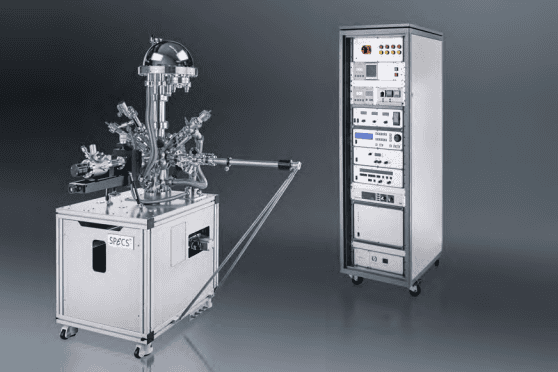 FlexMod
FlexMod is a series of specialized building-block type modules, that can be combined with each other or existing systems can later on be extended. There are well defined modules for XPS (FlexPS), SPM (FlexPM), Preparation (FlexPrep) and sample introduction (FlexIntro).
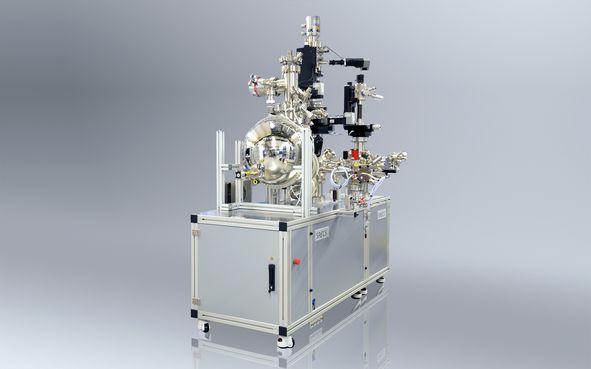 ProvenX
The product portfolio of SPECS is enlarged with the ProvenX (proven eXperience) System Series which represents the quintessence of our extensive knowledge in developing and manufacturing complete systems for surface analysis that fulfills the most demanding scientific requirements. The series contains dedicated systems for ARPES, µ-ARPES and Momentum Microscopy, XPS/UPS as well as NAP-XPS.
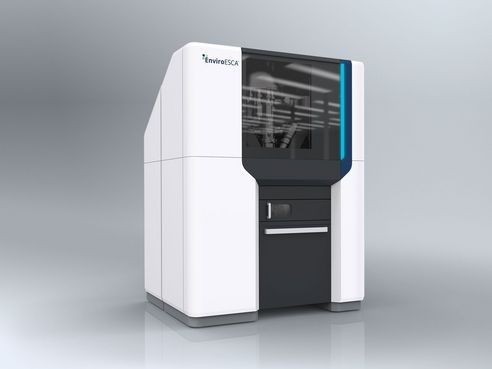 NAP-XPS
In (Near) Ambient Pressure (N)AP-XPS Systems samples can be characterized operando in pressures up to 100 mbar. Special differentially pumped analyzers, like the PHOIBOS 150 NAP are used. For excitation either a synchrotron beam line via the windowless beam entrance stage WBE 4 or a monochromated small spot X-ray source can be connected.
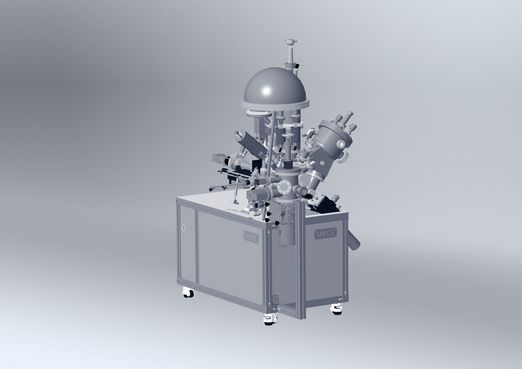 XPS-UPS Systems
XPS/UPS systems are a standard tool for the characterization of the chemical composition and the electronic structure of the surfaces of solids. Often a preparation chamber is integrated, so that samples inserted through the Load Lock chamber can be cleaned before analysis.
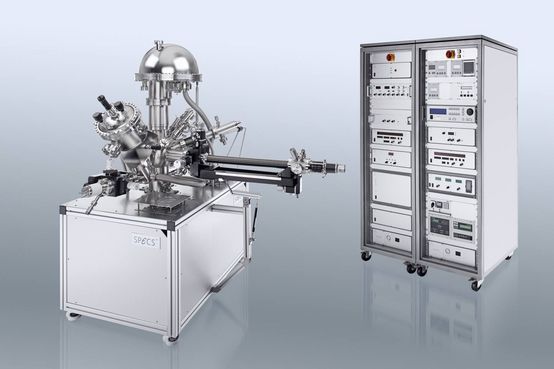 SEM/SAM - XPS Systems
This system is designed to perform XPS analysis with an X-Ray source, in combination with Scanning Electron and Auger Microscopy with an electron source and a secondary electron detector as part of the analysis system. With this system 2 analysis methods are combined to give a complementary, better and deeper understanding regarding sample surface properties.
 HAXPES Systems
Hard X-ray Photoelectron Spectroscopy (HAXPES) can be performed either at synchrotrons or with laboratory sources, like the µFOCUS 730 HE monochromator. The analyzers require higher voltages, making special power supplies and detectors necessary. Optimized geometries are needed for high count rates.
 ARPES/Spin-PES Systems
Angle-Resolved and Spin-Resolved Photoelectron Spectroscopy is very sensitive regarding the demands for ultimate energy and angle resolution. Thus, in ARPES and Spin-PES special system requirements are necessary: optimized geometries, lowest magnetic fields, special manipulators for ultralow sample temperatures, special UV or laser sources