Small Spot XPS System

Small Spot XPS System is designed to perform XPS analysis  with a small spot  X-Ray source, typically µ-FOCUS 500 or µ-Focus 600 with Rowland circle diameter of 500 or 600 mm and a variable spot size from under 200 µm to several hundred micrometers at power ranges from 10W to 150W. A single aluminum anode is fitted as standard. The advantages on the XPS analysis of this system in comparison with a non-monochromatic XPS System are the following:

  • Higher resolution
  • Higher sensitivity
  • Lower Background
  • No satellites
  • Reduced sample damage
  • µ-focused X-ray spot

It provides the scientist with an optimized solution.  The system allows to start with a basic configuration for Small spot XPS and expand with upgrade options towards improved performance or expand to additional analysis methods. This means the system can grow depending of additional requirements and needs.

The system basis consists basically in the following items:

  • Analysis chamber (stainless steel or µ-metal)
  • PHOIBOS Analyzer (100 or 150) with 1D or 2D detector
  • Manipulator with until 5 axis movement option and heating and cooling option
  • Small spot X-ray source (µ-FOCUS 500 or µ-FOCUS 600)
  • Water Cooling System for Source and pumping system
  • Load lock chamber for sample introduction with sample storage and sample heating options
  • Extension possibility for possible preparation or reaction chamber
  • Pumping system
  • Bake-out system
  • SPECS software for data acquisition, data analysis, remote control and automation possibility

Additional and optional items:

  • Ion gun for sample cleaning (IQE 11/35) (recommended)
  • Ion gun for sample cleaning and sputtering depth profiling (IQE 12/38)
  • Flood Gun (FG 22/35) for sample charge neutralization
  • Combination of Low energetic ion gun and Flood Gun for sample charge neutralization
  • Electron gun for Auger Spectroscopy (EQ 22/35)
  • Ultra Violet Source for UPS measurements (UVS 10/35 or UVS 300)
  • Sample camera
  • Laser pointer


Small Spot XPS System is designed to perform XPS analysis  with a small spot  X-Ray source, typically µ-FOCUS 500 or µ-Focus 600 with Rowland circle diameter of 500 or 600 mm and a variable spot size from under 200 µm to several hundred micrometers at power ranges from 10W to 150W. A single aluminum anode is fitted as standard. The advantages on the XPS analysis of this system in comparison with a non-monochromatic XPS System are the following:

  • Higher resolution
  • Higher sensitivity
  • Lower Background
  • No satellites
  • Reduced sample damage
  • µ-focused X-ray spot

It provides the scientist with an optimized solution.  The system allows to start with a basic configuration for Small spot XPS and expand with upgrade options towards improved performance or expand to additional analysis methods. This means the system can grow depending of additional requirements and needs.

The system basis consists basically in the following items:

  • Analysis chamber (stainless steel or µ-metal)
  • PHOIBOS Analyzer (100 or 150) with 1D or 2D detector
  • Manipulator with until 5 axis movement option and heating and cooling option
  • Small spot X-ray source (µ-FOCUS 500 or µ-FOCUS 600)
  • Water Cooling System for Source and pumping system
  • Load lock chamber for sample introduction with sample storage and sample heating options
  • Extension possibility for possible preparation or reaction chamber
  • Pumping system
  • Bake-out system
  • SPECS software for data acquisition, data analysis, remote control and automation possibility

Additional and optional items:

  • Ion gun for sample cleaning (IQE 11/35) (recommended)
  • Ion gun for sample cleaning and sputtering depth profiling (IQE 12/38)
  • Flood Gun (FG 22/35) for sample charge neutralization
  • Combination of Low energetic ion gun and Flood Gun for sample charge neutralization
  • Electron gun for Auger Spectroscopy (EQ 22/35)
  • Ultra Violet Source for UPS measurements (UVS 10/35 or UVS 300)
  • Sample camera
  • Laser pointer


XPS, Chemical Mapping

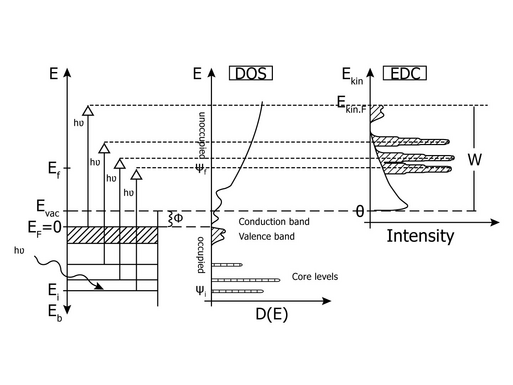
X-ray photoelectron spectroscopy (XPS) and Ultraviolet photoelectron Spectroscopy (UPS) is used to analyze the surface chemistry of a material. XPS spectra are obtained by illuminating the sample surface with monochromatic X-rays and eventually measuring the photo emitted electrons.

In 1905 Albert Einstein received the Nobel Prize in Physics for his quantum mechanical interpretation of the photoelectric effect. Based on the results of Heinrich Hertz and Max Planck about the nature of light being an electromagnetic wave and about the general existence of discrete energy portions, nowadays named “quantum”, this has been a big step for basic science. At this time nobody knew, that this will evolve into the most important method for non-destructive surface chemical analysis. To reach this understanding the development of energy dispersive electron analyzers had been necessary. Thus it took several decades until Kai Siegbahn developed and experimentally realized the first experiment of this kind in the late 1960s, again resulting in a Nobel Prize in Physics. By excitation of electrons from solid samples using characteristic X-rays and detecting the number of photoelectrons in dependence of their kinetic energies it became possible to use the element specific electron energies to derive the chemical
composition of sample surfaces without destroying them. He named the method Electron Spectroscopy for Chemical Analysis, or in short ESCA. The global success of X-ray Photoelectron Spectroscopy (XPS) is a result of the development of methods for reliable and precise quantification of ESCA data with an elemental detection limit of <1% in the uppermost surface layers. Elemental chemical mapping is possible by energy filtered imaging or mapping of the respective surface.

XPS basics
  • Chia sẻ qua viber bài: Small Spot XPS System
  • Chia sẻ qua reddit bài:Small Spot XPS System

PRODUCTS

Loading...

RELATED PRODUCTS

IQM Resonance – Quantum Cloud Platform

IQM Resonance – Quantum Cloud Platform Supplier: IQM – Finland IQM Resonance is a fully managed cloud-based quantum computing platform that provides instant access to advanced Quantum Processing Units (QPUs), ideal for enterprises, research institutes, and academic environments.
Xem thêm

IQM Radiance 20, 54 and 150 Qubits quantum computer

IQM Radiance 20, 54 and 150 Qubits quantum computer Model: IQM Radiance Manufacturer: IQM Quantum Computers - Finland Origin: Finland IQM Radiance is an advanced superconducting quantum computing platform designed for high-performance computing (HPC) centers, data centers, government agencies, and enterprises seeking to harness quantum advantage. With high-quality qubits and hybrid integration, Radiance is an ideal solution for practical applications in machine learning, cybersecurity, energy optimization, and chemical research.
Xem thêm

IQM Spark 5-qubit quantum computer

IQM Spark 5-qubit quantum computer Model: IQM Spark Manufacturer: IQM Quantum Computers – Finland Origin: Finland IQM Spark is a superconducting quantum computer system specifically designed for universities, research institutes, and laboratories to support education, quantum algorithm development, and research in the NISQ (Noisy Intermediate-Scale Quantum) era. With a cost-effective approach, this system offers high performance, flexible integration, and an optimized design for quantum research applications.
Xem thêm

UPDATE

WE HAVE MOVED TO
WWW.adst.vn

THANKS FOR YOUR VISIT OUR NEW WEBSITE!

VISIT NOW