Fertilizer application
Fertilizers are chemical compounds provided to plants to promote growth. Fertilizers can be organic (consisting of organic matter), or inorganic (made from simple, inorganic chemicals or minerals). They may be naturally occurring compounds such as peat or mineral deposits, or produced through natural processes (such as composting) or chemical processes (such as the Haber process ). Fertilizers typically provide three primary plant nutrients (nitrogen, phosphorus, potassium: NPK) in varying proportions, secondary plant nutrients (calcium, sulfur, magnesium) and sometimes other nutrients. trace elements (or trace elements). The particle size of fertilizer materials directly affects release rate, potency and working hazards such as dust generation. Natural organic fertilizers include manure, mud, vermicompost, peat, seaweed, wastewater and bird droppings. Green manure crops are also grown to add nutrients to the soil. The organic fertilizer produced includes compost, bone meal and seaweed extracts. Inorganic fertilizers are usually synthetic materials containing three main ingredients NPK. They are named or labeled according to the content of these three elements, which are macronutrients.

The fertilizer industry considers particle size analysis to be so important that a minimum frequency of measurements must be performed to ensure proper quality. Traditional techniques for analyzing the particle size of fertilizers have been refined, but companies are now looking for more effective measurement tools. Any technique considered for sieving replacement must be able to match previous sieving results, but provide efficiency in terms of speed, ease of use and long-term cost. The Dynamic CAMSIZER Image Analysis system meets each requirement.
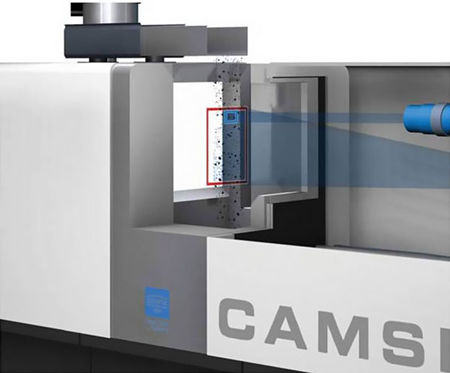
Manufacturing
For occupational health and safety (respirability of fertilizer powders) and environmental aspects (dust formation), fertilizer manufacturers are forced to granulate and crystallize fertilizers. This improves handling and does not affect the molecular structure of the product in any way. Monitoring the amount of fine particles has become an important criterion for fertilizer products. With a measuring range of 30 micrometers to 30 millimeters, CAMSIZER technology quantifies both the amount of fine particles and the desired particle size of the product. An optional ultrasonic accessory can also be used to disperse moderately cohesive particles.
Many, if not all, fertilizer manufacturers have established size specifications using sieves. And many times the situation requires any new measurement technology to meet similar specifications. CAMSIZER accomplishes this easily using a smart sieve attachment designed to calculate how a particle of a certain measurement shape will pass through a square sieve opening. Although the calculations are complex, creating each matching file is simple and quick. The user needs three inputs to create a match:
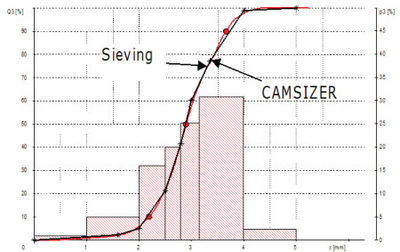
The integrated CAMSIZER Primary Fitting software then generates a matching file that can be enabled or disabled for each subsequent measurement of this specific material. See the images below for a comparison of typical results before and after applying the primary mounting method.
This feature allows CAMSIZER to conform to previous specifications and provides significant advantages in speed, accuracy and unit-to-unit consistency compared to sieves.

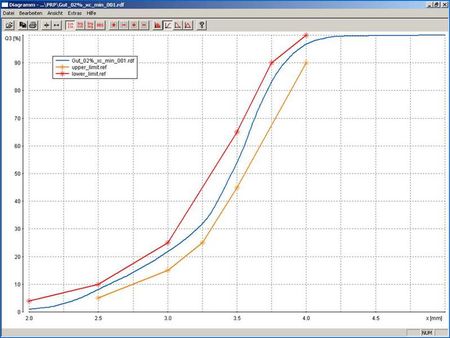
CAMSIZER comes with several software tools that make quality control easy. Visually displays pass/fail criteria (see image below) to quickly identify where material is within or out of specification. Choose to save images of all particles or only those that prevent more particles from passing through. These images provide irrefutable evidence and allow everyone to focus on solving the problem.
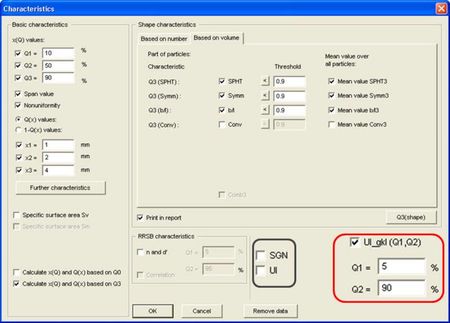
SGN calculations and a user interface are also provided for products or organizations that require these metrics.
Summary of benefits
Many satisfied CAMSIZER users in the fertilizer industry enjoy the following benefits:
■ Measurement is much faster than sieving
• Eliminate bottlenecks in the product release process
• Less time measuring, more time analyzing/improving
■ More accurate analytics improves rework and archive metrics
• Many users see productivity improvements of more than 50%
■ SOP-based measurements mean easy comparisons across shifts and plants
• Less time deciding if there's a problem, more time solving it
■ In-home and online installation available
■ Excellent tool reproducibility


