Introduction to TIMS

Introduction to TIMS

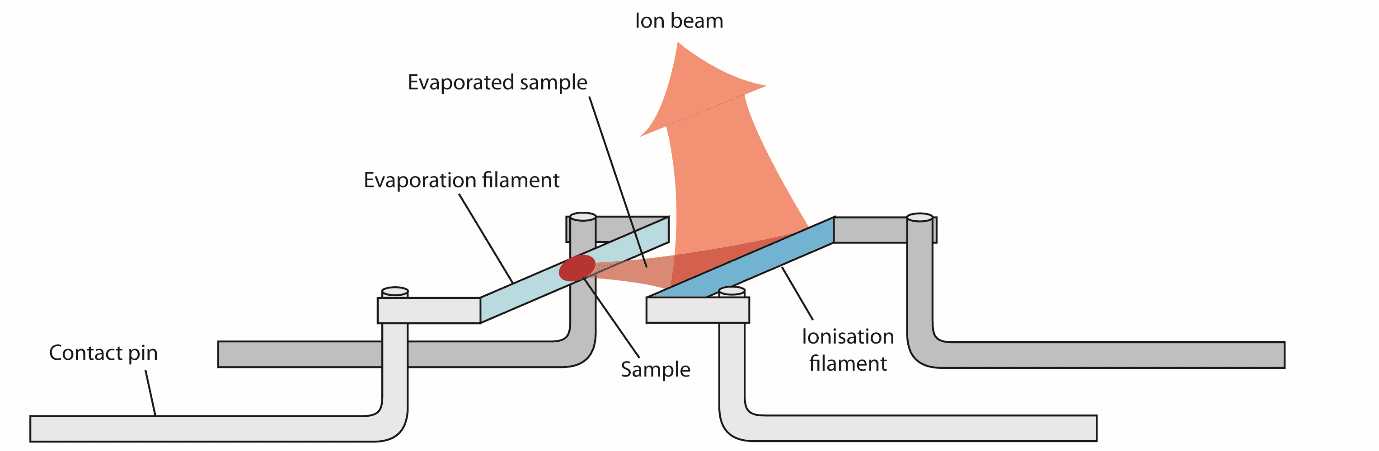
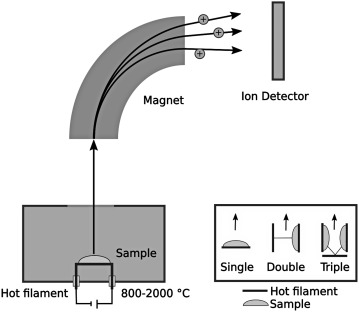
Thermal Ionisation Mass Spectrometry (TIMS) uses temperature to thermally ionise a solid sample for isotopic analysis. This is achieved by passing a current through a conducting metal filament, on which the sample is on, to temperatures often exceeding 1000°C. Single or double heated filaments of varying materials can be used, dependent on the element to be isotopically analysed. 


TIMS double filament technique is used to analyse samples that evaporate at a lower temperature to that at which they ionise. 

The ions that are formed are accelerated by a high voltage (up to 8000V) to pass through a magnetic sector analyser where they are separated by mass to charge ratio. Each separated isotope beam is collected simultaneously in an array of detectors and the isotope ratios can be calculated from the relative intensities.  TIMS is utilised around the world for isotopic analysis of elements such as Neodymium and Strontium in the geological field and Uranium for Nuclear applications such as safeguards. TIMS is also the preferred isotopic analysis technique for elements such as Osmium and Calcium, which are difficult to isotopically measure on other instruments such as ICP-MS.

Modern instruments are composed of three primary components: 1) ion source, the region in which ions are produced, accelerated, and focused; 2) analyzer, the region in which the beam is separated based on mass/charge ratios; and 3) collector, a region in which the ion beams are measured either sequentially (single collector) or simultaneously (multi-collector). The electronics of these instruments must operate to very close tolerances in order to produce isotope ratios that are precise to 0.01-0.001%.


The primary application of TIMS is to measure the isotope ratios of elements used in geochronology and tracer studies. Geochronology refers to the use of radioactive decay in closed systems to obtain the time of a specific geologic event, which is referred to as an age. Tracer applications refer to the use of the growth of daughter isotopes from radioactive decay to evaluate the interaction between geochemical systems and/or reservoirs. This application provides only general chronologic information, often referred to as model ages, which more loosely constrain the timing of geologic processes and the development of, and interaction between, geochemical reservoirs.

For terrestrial systems, common applications in geochronology and tracer Studies involve the following radiometric systems

  • U-Th-Pb
  • Rb-Sr
  • Sm-Nd
  • Lu-Hf
  • Re-Os
  • U series disequilibrium
  • Sr, Nd, Hf, Os in seawater

In cosmochemical systems, the measurement of isotopic compositions is primarily as tracers of nucleosynthetic processes and constraining the evolution of the solar system. This involves measurement of the systems noted above, but also includes the decay of short lived radionuclides, as observed principally in meteorites. In addition to the systems noted above, systems of cosmochemical interest include:

  • Fe-Ni
  • Mn-Cr
  • Al-Mg
  • Zr-Mo
  • Mo-Ru

Non-radiogenic (stable) isotope-isotope ratios are typically used to characterize exchange processes, track reservoir interactions, and evaluate biologic and kinetic processes:

  • Li
  • B
  • Mg
  • Ca
  • Fe

Strengths
The advantage of TIMS compared to other isotope ratio techniques include:

  • the chemical and physical stability of the measurement environment, which lead to highly precise measurements,
  • the ability to ionize and evaporate samples at different temperatures by using multiple filament assemblies,
  • lower and more consistent average mass fractionation,
  • the use of single element solutions to eliminate isobaric interferences,
  • production of ions with a restricted range of energies (eliminates need for energy filter),
  • easily automated operation, and
  • near 100% transmission of ions from source to collector.

Limitations
The disadvantages include:

  • not all elements are easily ionized, which restricts applications to elements with low ionization potentials;
  • ionization is not equally efficient for all elements, and is generally less than 1%;
  • mass fractionation continually changes during analysis;
  • elementally pure solutions are required to avoid isobaric interferences, which requires extensive preparation; and
  • accurate mass fractionation correction is limited to elements with 3 or more isotopes of which at least 2 are stable.
     
  • Chia sẻ qua viber bài: Introduction to TIMS
  • Chia sẻ qua reddit bài:Introduction to TIMS

PRODUCTS

Loading...

RELATED PRODUCTS

IQM Resonance – Quantum Cloud Platform

IQM Resonance – Quantum Cloud Platform Supplier: IQM – Finland IQM Resonance is a fully managed cloud-based quantum computing platform that provides instant access to advanced Quantum Processing Units (QPUs), ideal for enterprises, research institutes, and academic environments.
Xem thêm

IQM Radiance 20, 54 and 150 Qubits quantum computer

IQM Radiance 20, 54 and 150 Qubits quantum computer Model: IQM Radiance Manufacturer: IQM Quantum Computers - Finland Origin: Finland IQM Radiance is an advanced superconducting quantum computing platform designed for high-performance computing (HPC) centers, data centers, government agencies, and enterprises seeking to harness quantum advantage. With high-quality qubits and hybrid integration, Radiance is an ideal solution for practical applications in machine learning, cybersecurity, energy optimization, and chemical research.
Xem thêm

IQM Spark 5-qubit quantum computer

IQM Spark 5-qubit quantum computer Model: IQM Spark Manufacturer: IQM Quantum Computers – Finland Origin: Finland IQM Spark is a superconducting quantum computer system specifically designed for universities, research institutes, and laboratories to support education, quantum algorithm development, and research in the NISQ (Noisy Intermediate-Scale Quantum) era. With a cost-effective approach, this system offers high performance, flexible integration, and an optimized design for quantum research applications.
Xem thêm

LD250 Dilution Refrigerator Measurement System

LD250 Dilution Refrigerator Measurement System Model: LD250 Manufacturer: Bluefors - Finland Origin: Finland Designed to provide an ultra-low temperature environment (below 10 mK) for quantum experiments and low-temperature physics research, the LD250 system stands out with its rapid cooling capability, automated operation, and open design for easy access to the experimental space. It is optimized to deliver high cooling power, making it suitable for experiments requiring large sample spaces and robust cooling performance.  
Xem thêm