The primary application of TIMS is to measure the isotope ratios of elements used in geochronology and tracer studies. Geochronology refers to the use of radioactive decay in closed systems to obtain the time of a specific geologic event, which is referred to as an age. Tracer applications refer to the use of the growth of daughter isotopes from radioactive decay to evaluate the interaction between geochemical systems and/or reservoirs. This application provides only general chronologic information, often referred to as model ages, which more loosely constrain the timing of geologic processes and the development of, and interaction between, geochemical reservoirs.
For terrestrial systems, common applications in geochronology and tracer Studies involve the following radiometric systems
- U-Th-Pb
- Rb-Sr
- Sm-Nd
- Lu-Hf
- Re-Os
- U series disequilibrium
- Sr, Nd, Hf, Os in seawater
In cosmochemical systems, the measurement of isotopic compositions is primarily as tracers of nucleosynthetic processes and constraining the evolution of the solar system. This involves measurement of the systems noted above, but also includes the decay of short lived radionuclides, as observed principally in meteorites. In addition to the systems noted above, systems of cosmochemical interest include:
- Fe-Ni
- Mn-Cr
- Al-Mg
- Zr-Mo
- Mo-Ru
Non-radiogenic (stable) isotope-isotope ratios are typically used to characterize exchange processes, track reservoir interactions, and evaluate biologic and kinetic processes:


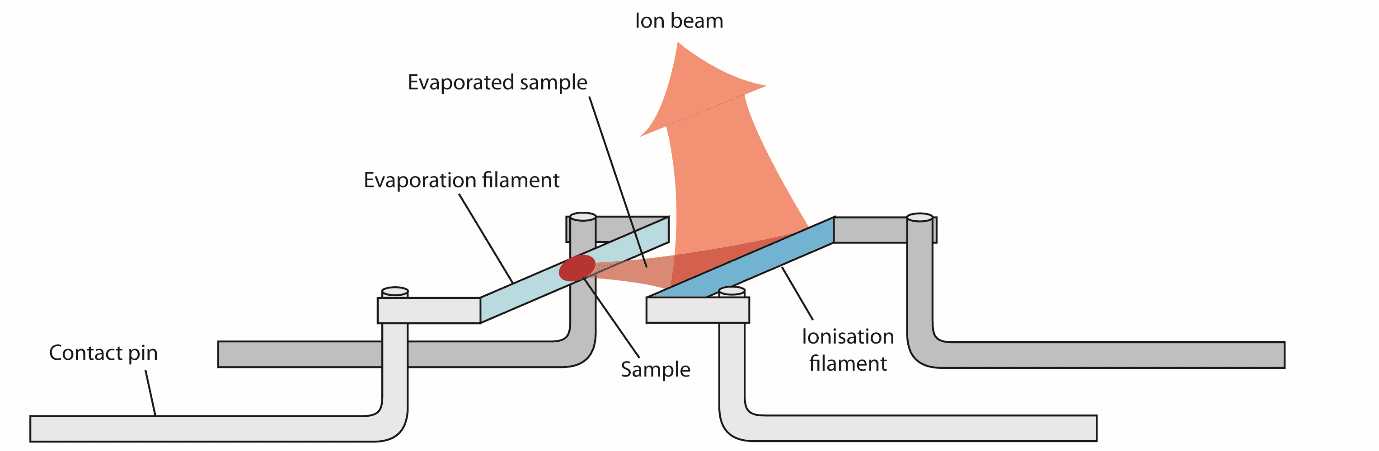
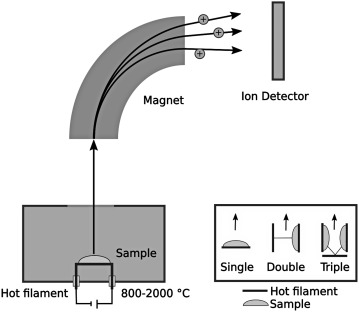 Modern instruments are composed of three primary components: 1) ion source, the region in which ions are produced, accelerated, and focused; 2) analyzer, the region in which the beam is separated based on mass/charge ratios; and 3) collector, a region in which the ion beams are measured either sequentially (single collector) or simultaneously (multi-collector). The electronics of these instruments must operate to very close tolerances in order to produce isotope ratios that are precise to 0.01-0.001%.
