Khối phổ ion thứ cấp SIMS 7f-Auto

IMS 7f-Auto là phiên bản mới nhất của dòng sản phẩm Máy quang phổ khối ion thứ cấp IMS xf (SIMS) thành công của CAMECA. Được thiết kế để phân tích các nguyên tố và đồng vị có độ chính xác cao với tính dễ sử dụng và năng suất cao hơn, nó được tối ưu hóa cho các ứng dụng đầy thách thức như thủy tinh, kim loại, gốm sứ, thiết bị dựa trên Si, III-V và II-VI, vật liệu rời, màng mỏng... đáp ứng các yêu cầu của các ngành trong phát triển hiệu quả thiết bị và kiểm soát quy trình.

Đặc điểm chính
IMS 7f-Auto cung cấp mặt cắt với độ sâu ảnh vô song, độ phân giải độ sâu cao và dải động học lớn. Máy quang phổ khối có tỷ lệ truyền qua lớn được kết hợp với hai nguồn ion mật độ cao O2+ và Cs+, do đó cung cấp tốc độ phún xạ nhanh và giới hạn phát hiện tuyệt vời. Một thiết kế quang học độc đáo cho phép chụp ảnh cả kính hiển vi ion và hiển vi đầu dò quét.

Tăng cường tự động hóa & hiệu quả hoạt động
IMS 7f-Auto được trang bị một cột sơ cấp thẳng hàng, chùm tia sơ cấp có thể được chỉnh dễ dàng hơn và nhanh hơn cũng như độ ổn định dòng điện của chùm tia sơ cấp được tối ưu hóa. Các quy trình tự động mới giảm thiểu các sai lệch liên quan đến người vận hành và cải thiện tính dễ sử dụng. Buồng mẫu động cơ với khả năng tự động nạp/dỡ giá đỡ mẫu đảm bảo năng suất cao thông qua chuỗi phân tích và vận hành từ xa.

Độ lặp lại cao ở thông lượng lớn
Nhờ có buồng lưu trữ và chuyển mẫu được gắn động cơ mới, IMS 7f-Auto có thể phân tích nhiều mẫu ở chế độ liên kết hoặc từ xa. Các phép đo có thể hoàn toàn tự động không cần giám sát , với thông lượng và khả năng tái tạo vô song. Thiết bị có thể đạt được khả năng lặp lại cao nhất (RSD < 0,5 %), cùng với giới hạn phát hiện tuyệt vời, thông lượng và năng suất cao (có thể được sử dụng 24 giờ một ngày với sự can thiệp tối thiểu của người vận hành).

SIMS detects trapped hydrogen in alloys

Detecting trapped hydrogen in aluminum alloy (SIMS)

Dynamic SIMS is recognized as one of the most promising techniques to visualize the local distribution of H atoms in metallic materials, and the IMS 7f-Auto proves a tool of choice for hydrogen embrittlement studies thanks to...Keep Reading

oxygen-depth-profiling-in-steel

Oxygen depth profiling in Zn coated steel (SIMS)

The IMS 7f-Auto offers unique depth profiling and ion imaging capabilities which are useful for the study of inclusions and segregation effects in alloys. Keep Reading

Small area analysis in Sn Cu wire structure with SIMS

Small area analysis in Sn-Cu wire structures (SIMS)

Thanks to its outstanding imaging capabilities, the IMS 7f-Auto is a tool of choice for R&D of advanced engineering materials: diffusion in polycrystalline samples, surface imaging analysis...Keep Reading

Deep and shallow implant depth profiling

Deep and shallow implant depth profiling (SIMS)

The IMS 7f-Auto is widely used for dopant monitoring in the semiconductor industry, and applied to different species and material systems. Keep Reading

Impurity control with SIMS - O depth profile in Si

Impurity control (SIMS)

Dynamic SIMS is one of the most efficient techniques for measuring trace concentrations of impurities in semiconductors. Keep Reading

Dopant monitoring in LEDs with SIMS

Dopant monitoring in LED devices (SIMS)

CAMECA SIMS instruments are extremely useful in investigating the composition and characterizing the elemental distribution of dopants and impurities on different layers, making them your best choice for R&D and process...Keep Reading

SIMS depth profiling of Nitrogen doping in Cu2O

Materials for Energy & Catalysis (SIMS)

SIMS nitrogen concentration depth profiles in Cuprous oxide (Cu2O) films doped with nitrogen plasma help enhancing the conductivity of this material used for low-cost solar-energy conversion and photocatalysis. Keep Reading

CIGS thin film solar cells

CIGS thin film solar cells (SIMS)

Dynamic SIMS instruments are best fit to characterize the elemental in-depth distribution (matrix species & alkali metals Na and K) in various different CIGS thin films. Keep Reading

Purity control in PV Si feedstock

Purity control in PV Si feedstock (SIMS)

The IMS 7f-Auto is the tool of choice for quality control of the Si purification process which is mandatory to ensure high yield manufacturing of Si-based solar cell devices. Keep Reading

Nuclear waste management - SIMS depth profiling in nuclear glass

Nuclear glass alteration mechanisms (SIMS)

Offering excellent depth profiling capabilities for low concentration elements and high precision isotopic analyses, the IMS 7f-Auto is a powerful tool for analyzing nuclear glasses. Keep Reading

Helium in nuclear reactor - SIMS depth profile

Helium migration in nuclear reactors (SIMS)

Compared to other techniques commonly used for the analysis of nuclear materials, SIMS provides better sensitivity, dynamic range and depth resolution.  Keep Reading


IMS 7f-Auto video

IMS 7f-Auto Automation

See the IMS 7f-Auto in action in our last video: high analytical performance with full automation & ease of use - The leader Secondary Ion Mass Spectrometry sensitivity and throughput. You too can get your data overnight!


Optimization of carbon detection limit in Silicon using the raster change methodSeoyoun (Joan) Choi, CAMECA expert application engineer for SIMS, presents applications of the “raster change” dynamic SIMS method for measuring the carbon concentration in silicon samples. Click here to view


Lithium Diffusion In Li-Ion Battery Materials Revealed By SIMSLearn from Dr Naoaki Kuwata, NIMS, Japan, how Secondary Ion Mass Spectrometry can be used to accurately measure lithium diffusion coefficients in Li-based thin films, supporting Li-ion battery material optimization. Click here to view


Trace Level SIMS Quantitation For Particle Accelerators

Dr Jonathan Angle reviews SIMS methodologies developed at Virginia Tech to solve mysteries specific to the characterization of SRF cavities, (predictive modeling of O diffusion, identification of contaminants from cavity furnace treatments, etc.).Click here to view


Using SIMS for materials development of high-performance solid oxide fuel cellsKatherine Develos-Bagarinao will present her most recent research projects on SOFCs using Secondary Ion Mass Spectrometry (SIMS) as a primary characterization tool. Click here to view


Application of SIMS in Solar PV Research: The Role of Hydrogen in Crystalline Silicon Solar CellsIn this webinar, Dr Di Kang will present results suggesting that, to achieve the highest passivation quality, an optimum amount of hydrogen surrounding the interfacial SiOx is needed, while insufficient or excess hydrogen can both lead to degradation of poly-Si passivation. Click here to view


The Principles of Dynamic SIMS

This free on-demand webinar is an excellent introduction to the dynamic SIMS technique. Different practical aspects are discussed:


  • Choice of primary and secondary beam species
  • Relative sensitivity for various elements
  • Matrix effects
  • Depth resolution & Lateral resolution
  • Depth profiling (choice of impact energy & sputtering rate, calibration method)
  • Scanning ion imaging mode
  • A summary of dynamic SIMS main analytical characteristics is provided at the end.

Click here to view


  • SIMS analysis of an oxide thin film with continuous composition gradient

    Explore the application of Dynamic SIMS on thin film analysis with our speaker Joseph Scola, from the University of Paris-Saclay/UVSQ.
    ↓ Watch the webinar on demand or download our one-pager document highlighting the key takeaways.

    Click here to view

  • Enhanced Characterization of Very Deep Proton Implants with Dynamic SIMS

    Explore the superior capabilities of Dynamic SIMS for analyzing low-dose deep proton implants in industrially relevant silicon with Orazio Samperi, University of Catania/STMicroelectronics Key take aways include: The importance of proton implantation, the pivotal role of Dynamic Secondary Ion Mass Spectrometry for analyzing low-dose deep proton implants in silicon, ensuring quality and performance of semiconductor devices and a new protocol enabling reliable depth profiling of H implants with concentrations in the order of 1E16cm-3, exceeding depths of 20 μm! .
    ↓ Duration: 60 minutes

    Click here to view

  • Advancing High-Efficiency Silicon Solar Cells through Inkjet Printing of Polysilicon Passivating Contacts: Insights from SIMS Analysis - Webinar

    Australian National University scientists Dr. Sieu Pheng Phang and Ms Jiali Wang report on the use of Dynamic SIMS to characterize inkjet-printed passivating contacts for improved silicon solar cells.
    ↓ Duration: 38 minutes

    Click here to view

  • Optimization of carbon detection limit in Silicon using the raster change method

    Seoyoun (Joan) Choi, CAMECA expert application engineer for SIMS, presents applications of the “raster change” dynamic SIMS method for measuring the carbon concentration in silicon samples.
    ↓ Duration: 14 minutes

    Click here to view

  • Lithium Diffusion In Li-Ion Battery Materials Revealed By SIMS

    Learn from Dr Naoaki Kuwata, NIMS, Japan, how Secondary Ion Mass Spectrometry can be used to accurately measure lithium diffusion coefficients in Li-based thin films, supporting Li-ion battery material optimization..
    ↓ Duration: 18 minutes

    Click here to view


An Excel spreadsheet compiling scientific research articles using the IMS xf (IMS 3f, 4f, 5f, 6f, 7f, IMS 7f-Auto, IMS 7f-GEO). The articles are ordered by main applications as below and are easily searchable with Excel word search functions:

  • Materials
  • Geosciences
  • Nuclears

Download speadsheet here

SmartPro news

SmartPRO

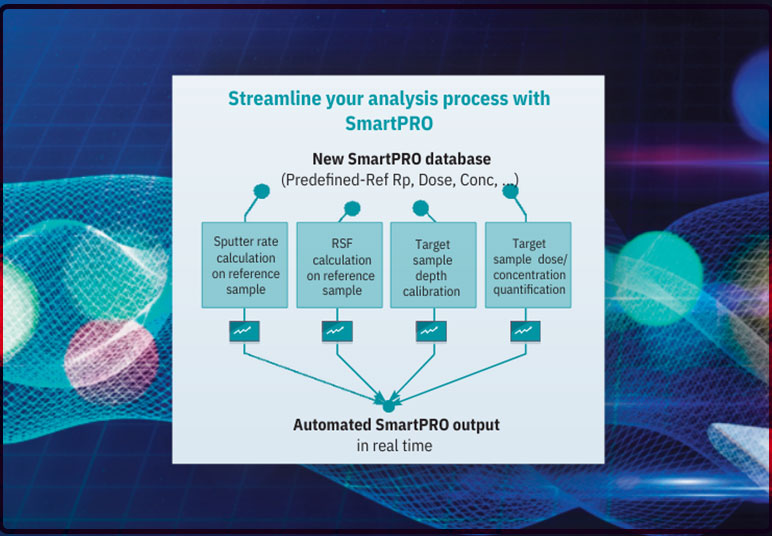
The new SmartPRO software package for CAMECA IMS 7f-Auto, IMS Wf and SC Ultra Secondary Ion Mass Spectrometers combines Chain Analysis and WinCurve in a seamlessly integrated environment and adds real time data processing and...


Keep Reading

WinCurve dataprocessing sofware

WinCurve

Specifically developed for CAMECA SIMS instruments, WinCurve offers powerful data processing & visualization capabilities in a user-friendly environment.


Keep Reading

WinImage Software

WinImage II

Specifically developed for CAMECA SIMS instruments, WinImage II offers powerful image visualization, processing & printing capabilities under PC-Windows™ Environment.


Keep Reading

APM Software

APM

Automated Particle Measurement (APM) is CAMECA software tool allowing fast screening of millions of particles, particle detection and isotopic characterization.


Keep Reading

Specific to IMS 6f users: extend the lifetime of your instrument with our IMS 6f overhaul program:
IMS 6f ion microprobes are robust, but old instruments whose electronic components are becoming obsolete. To minimize the risk of long, non-scheduled downtime, CAMECA  offers an IMS 6f overhaul program, that will fully rejuvenate your instrument with a complete new electronics system, pumping and vacuum, new hardware, full automation, user-friendly acquisition and processing software, etc...
Download the IMS 6f-E7 upgrade flyer for all details of this upgrade and its benefits in terms of performance, productivity, ease-of-use, and of course, uptime and sustainability.


To view upgrade options available for IMS 6f-E7 and 7f, click on either of the components below:
Automation & Software
Sources
Airlock
Specimen Chamber
Optical System
Vacuum

Automation & Software

PC-Automation (7f equipped with SUN workstation)
PC automation system to replace SUN system, allows full automation & unattended operation and greatly improves performance and throughput.

Post-treatment Station (6f-E7/ 7f)
PC computer for off-line data processing (CAMECA software not included).

Desk Control Duplication (7f with PC-Automation / 6f-E7)
Instrument control from an operator room. Ensures optimized operation comfort when the lab is split in two parts.

APM Software Licence (PC-Automation / 6f-E7 /7f with PC-Automation)
Automated Particle Measurement software program for fast screening of large numbers of particles and detection of specific elements or isotopes. More information.

WinCurve Software Licence (offline) (7f / 6f-E7)
Offers powerful SIMS data processing & graphing capabilities. More information.

WinImage II Software Licence (offline) (7f / 6f-E7)
Offers powerful SIMS image processing capabilities. More information.
 

Top of page

Sources

Cs Ion Source Isolation (7f with PC-Automation)
Isolation and Pumping of the Cesium Microbeam Source.

Duo Accel/Decel (7f with PC-Automation)
Low primary ion energy system for the duoplasmatron source.

Top of page

Airlock

Storage Chamber Upgrade (7f with PC-Automation / 6f-E7)
Manual storage chamber with its load-lock designed to store up to six sample holders under high vacuum. Ensures substantial throughput improvements for applications that depend on the best UHV conditions. 

Top of page

Specimen chamber

Z-Motion (7f with PC-Automation / 6f-E7)
Z-Axis manual adjustment for the sample stage.

Turbospectro upgrade (7f with PC-Automation / 6f-E7)
Turbomolecular pumps for the mass spectrometer (to replace the existing ion pumps, for optimized pumping speed in the mass spectrometer and improved abundance sensitivity while using the oxygen flooding.

Digital Video Camera (7f with PC-Automation / 6f-E7)
Numerical camera and LED sample illustration system (white light).

EPS (7f with PC-Automation)
Electrical isolation of the magnet flight tube in order to allow fast mass peak switching.

Top of page


Secondary Optical System

EM Detector Post-accelaration (7f with PC-Automation)
Postacceleration for the electron multiplier detector. Increases sensitivity when analysing heavy elements and when running the mass spectrometer at low secondary extraction voltage (<3 kV).
 

Vacuum

Pfeiffer Turbopump 7f
Peiiffer Turbopump 6fe7


  • Chia sẻ qua viber bài: Khối phổ ion thứ cấp SIMS 7f-Auto
  • Chia sẻ qua reddit bài:Khối phổ ion thứ cấp SIMS 7f-Auto

sản phẩm

Loading...

Sản phẩm liên quan

Hệ thống Quang khắc không mặt nạ đầu dò nhiệt NanoFrazor

NanoFrazor dùng công nghệ khắc nhiệt không mặt nạ (t-SPL) với đầu dò siêu nhọn, tạo cấu trúc nano chính xác cao, không cần chùm điện tử hay mặt nạ đắt tiền. Độ sâu khắc sai số <1nm, tích hợp kiểm tra in-situ, hỗ trợ grayscale 3D cho quang tử nano, cảm biến lượng tử, màng sinh học. Module Decapede 10 đầu dò giúp tăng thông lượng gấp 10 lần.
Xem thêm

Hệ thống Quang khắc không mặt nạ sản xuất khối lượng lớn MLA 300

MLA 300 được tối ưu cho sản xuất khối lượng lớn. Công nghệ Spatial Light Modulator (SLM) cho phép hiệu chỉnh biến dạng theo từng die, tự động lấy nét theo bề mặt cong, tương thích với SECS/GEM. Loại bỏ hoàn toàn chi phí và rắc rối của mask vật lý. Ứng dụng trong sản xuất MEMS, cảm biến, ASIC, advanced packaging, power electronics.
Xem thêm

Hệ thống Quang khắc không mặt nạ Grayscale DWL 2000 GS / 4000 GS

DWL 2000 GS / 4000 GS đáp ứng chuẩn công nghiệp, hỗ trợ xuất CAD với 1023 mức xám. Công nghệ Grayscale độc quyền từ Heidelberg Instruments cho phép tạo cấu trúc 2.5D và vi thấu kính với độ nhám bề mặt xuống 5nm. Giải pháp tối ưu cho chế tạo hologram, bộ khuếch tán ánh sáng và thấu kính Fresnel trong nghiên cứu quang tử, vi quang học.
Xem thêm

TIN MỚI

CHÚNG TÔI ĐÃ CHUYỂN TỚI WWW.adst.vn

CÁM ƠN BẠN ĐÃ GHÉ THĂM WEBSITE MỚI CỦA CHÚNG TÔI!

CHUYỂN TRANG