Mass resolution 0.00x amu. Particles with the same nominal mass (Si and C2H4, for example, both have mass = 28) are easy to distinguish from each other because Mr. Einstein was predicting a small mass shift as the atoms entered the bound state.
Mass resolution 0-10,000 amu; can detect ions (positive or negative), isotopes, and molecular compounds (including polymers, organic compounds, and up to ~amino acids).
Tracking element detection limits within range.
Tracer element detection limits are in the ppm range.
Depth profiling capabilities; Surface sputtering allows chemical stratigraphic analysis of the material surface (typical sputtering speed is ~100 A/minute).
Retrospective analysis. Each pixel of the ToF-SIMS map represents a full mass spectrum. This allows an analyst to retrospectively produce maps for any volume of interest, and to expose regions of interest (ROIs) in terms of their chemical composition through post-processing. dataset collected using the tool.
ToF-SIMS uses a focused, pulsed particle beam (usually Cs or Ga) to dislodge chemicals on the surface of the material. Particles created closer to the impact site tend to dissociate into ions (positive or negative). Secondary particles produced farther from the impact site tend to be molecular compounds, typically fragments of much larger organic macromolecules. The particles are then accelerated into a flight path on their way to a detector. Because the "time of flight" of particles from impact to detection can be measured on the nanosecond scale, mass resolutions as small as 0.00X atomic mass units (i.e. is one-thousandth the mass of a proton). Under typical operating conditions, ToF-SIMS analysis results include:
A mass spectrometer surveys all masses in the range of 0-10,000 amu,
The distributed beam creates maps of any volume of interest on a sub-micron scale
The depth profile was created by removing the surface layers by sputtering under an ion beam.
ToF-SIMS is also known as "static" SIMS because a low primary ion current is used to "tickle" the sample surface to release ions, molecules, and molecular clusters for analysis. In contrast, "dynamic" SIMS is the method of choice for quantitative analysis because the higher main ion current leads to faster sputtering rates and produces much higher ion yields. Therefore, dynamic SIMS produces better counting statistics for trace elements. Organic compounds are effectively destroyed by "dynamic" SIMS and no diagnostic information is obtained.

Instrument diagram of the Charles Evans TRIFT ToF-SIMS instrument. ToF-SIMS devices typically include the following components:
An ultra-high vacuum system, necessary to increase the mean free path of ions released along the ion flight path
Particle guns, usually using Ga or Cs sources;
Ion paths are designed to be circular, often using an electrostatic analyzer to direct the particle beam (picture below shows Charles Evans TRIFT's design), or linear using reflectors (see more about the design of the "reflector" of Cameca's IonTOF system);
Mass detection system.

Schematic diagram of the CAMECA IonTOF ToF-SIMS device. ToF-SIMS devices are also equipped with a computer with powerful hardware and software for system control and analysis. One of the main features of the ToF-SIMS software is the ability to perform "recollection" analysis, that is, each molecule from the sample detected by the system can be stored by the computer as a function of its mass. its quantity and origin. This allows users to obtain chemical or spectral maps of specific areas that have not been previously identified after the original data has been collected.

Elemental/Molecular Survey;
Elemental/Molecular Map;
Depth profile.
In principle, ToF-SIMS is applicable to any surface-mediated such as: catalysis, adsorption, redox and dissolution/precipitation reactions. Only recently has ToF-SIMS been applied to geological materials. Some examples:
Organic film of mineral grain boundaries
Identification of organic biomarkers in the rock record
Characteristics of organic macromolecules in coal mines
Analysis of metals precipitated from magmatic fluids in seafloor hydrothermal systems
Analysis of interplanetary dust particles
What are the strengths and limitations of Time-of-Flight Secondary Ion Mass Spectrometry (ToF-SIMS)?
Strength
• Survey all volumes on the surface of the material; they can include single ions (positive or negative), individual isotopes, and molecular compounds;
• Elemental and chemical mapping at sub-micrometer scales;
• High mass resolution, to distinguish species with similar nominal masses (mass resolution of at least 0.00x amu);
• High sensitivity to trace elements or compounds, on the order of ppm to ppb for most species;
• Surface analysis of insulating and conductive samples;
• Depth profiling (in near-surface environments, on the order of individual atomic layers down to 10s nanometers);
• Non-destructive analysis;
• Retrospective analysis, for post-acquisition analysis and interpretation of stored images and spectra.
Limit
• Generally does not produce quantitative analyzes (preferably semi-quantitative);
• Optical capabilities are often limited, making it difficult to find particles or specific regions of interest for analysis;
• Charging may be a problem in some models, although the charge compensation procedure is generally sufficient to overcome these problems;
• There is often an image change when switching from positive to negative ion data collection mode; This makes it difficult to collect positive and negative ion data on the same site;
• Too much data; The benefit of retrospective analysis is also its curse. Each pixel of the image produced by ToF-SIMS also contains the full mass spectrum for that point. Therefore, it can take hours, days, or weeks to fully analyze a data set. Therefore, it is extremely important to have a very clear purpose in collecting ToF-SIMS data and to focus on data analysis and interpretation that is specifically relevant to the question at hand.
Instructions for User - Sample Collection and Preparation
ToF-SIMS is extremely sensitive to any sample preparation treatment: there are often residues associated with any sample pre-treatment, and there is always "unexpected" (or environmental) contamination. in the form of compounds absorbed onto the material surface from the air. In general, we attempt to analyze samples "as received." Solid materials (e.g. mineral granules) are often pressed into an Indium foil, which is both ductile and conductive. Any mapping of the sample prior to introduction into the sample chamber will greatly increase the ability to find and identify areas of interest. As a first step of the analysis process, we will typically "dust" the surface with a very light sputtering period (<1 minute) to try to clean off any absorbed surface contamination.
Collect data, results
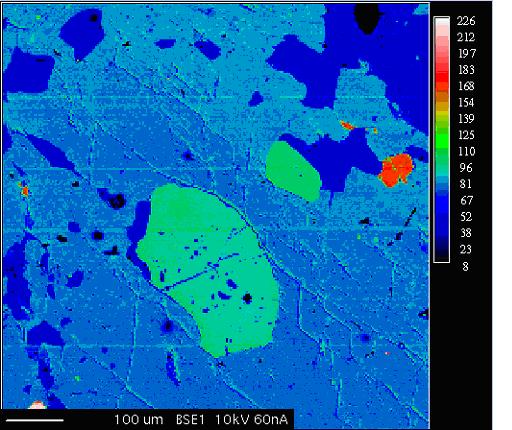
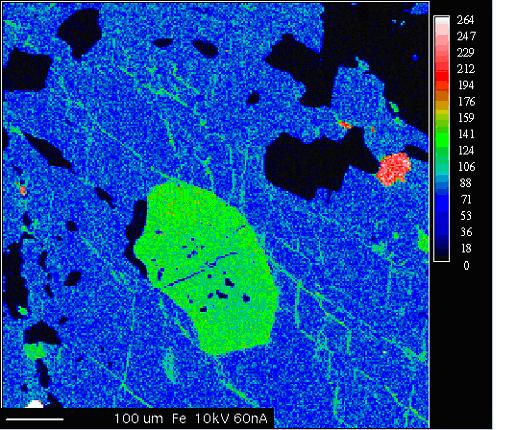
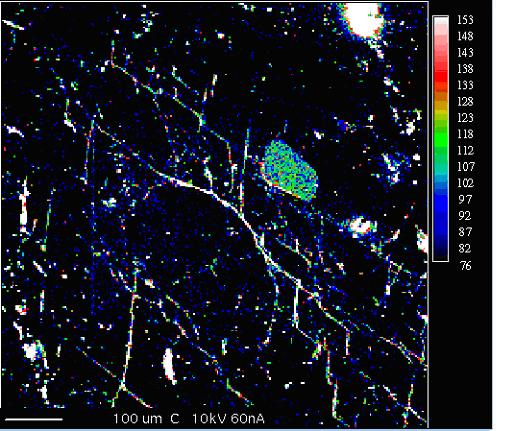
An example of ToF-SIMS elemental mapping of a garnet dipole from deep borehole KTB, Germany. A network of carbon bonds can be seen on grain boundaries and cleavage traces. From Mogk and Mathez (2000).