NanoSIMS 50L

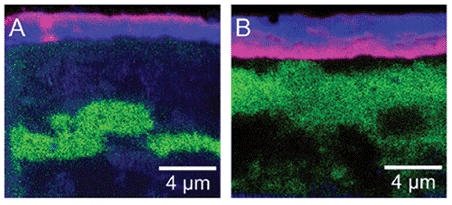
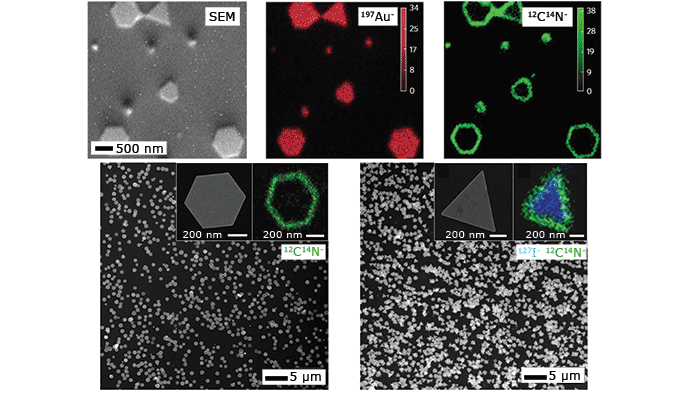
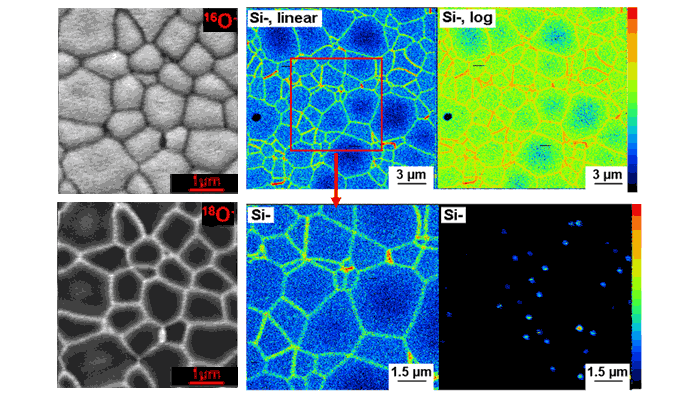
The NanoSIMS 50L delivers simultaneous key performance metrics that can only be obtained individually with any other known instrument or technique:

  • High analysis spatial resolution (down to 50 nanometers)
  • High sensitivity (ppm in element imaging)
  • High Mass Resolution (M/dM),
  • Parallel acquisition of seven masses
  • Fast acquisition (DC mode, not pulsed)
  • Analysis of electrically conductive samples without problem.

And thanks to recent improvements, isotope ratio reproducibility of a few tenths of permil can now be achieved.

Extended fields of applications

Microbiology :
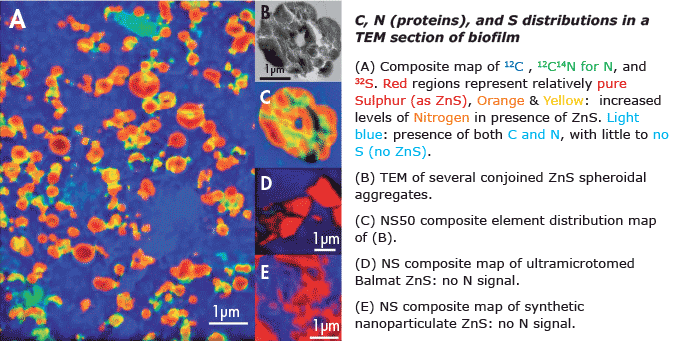
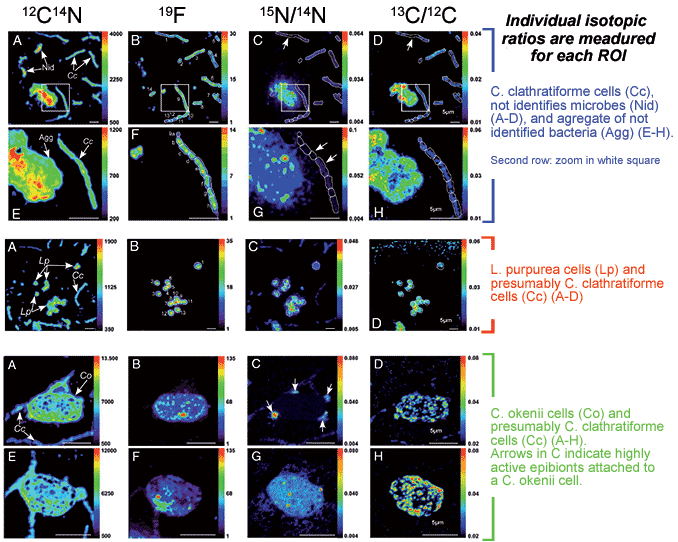
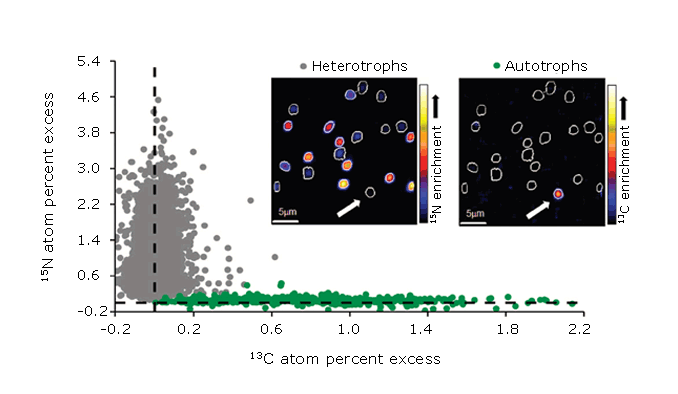
The NanoSIMS 50L opens new possibilities for coupling phylogenetic identity (with FISH or El-FISH) and metabolic function (using stable isotope labeling) of single cells in studies of mixed microbial communities from the environment.

Cell biology:
50nm resolution and isotopic ratio capabilities of the NanoSIMS 50L allow intra-cellular measurement of accumulations and fluxes of molecules labeled with stable isotopes

Geology and space science:

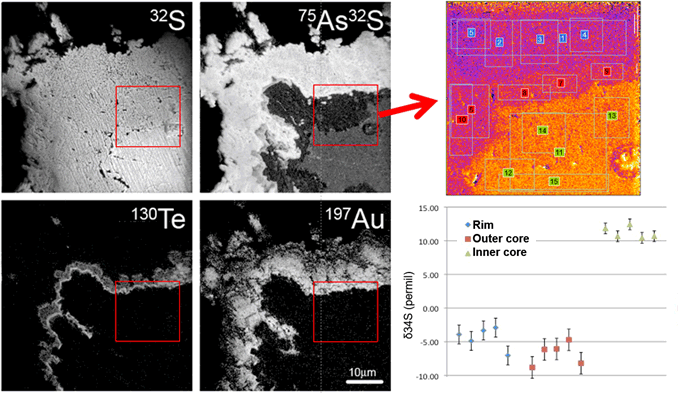
The NanoSIMS 50L allows precise isotopic and elemental measurements of deep sub-micron areas, grains or inclusions from interplanetary dust particles, meteorites, and mineral sections. Working in multiple Faraday Cup configuration and with spot size of a few µm, it delivers isotope ratio measurements with precision and external reproducibility down to a few tenths of permil.

Materials Research:

Thanks to its high sensitivity at high mass resolution (no mass interference), the NanoSIMS 50L allows trace element (dopant) imaging & quantification with 50nm SIMS lateral resolution, even in electrically insulating materials. All elements except noble gases are accessible, from hydrogen to plutonium.

The NanoSIMS 50L was originally designed by Pr. G. Slodzian, University of Paris Sud, France.

  • Revealing the intracellular distributions of biomolecules with a novel NanoSIMS-based methodology

    Melanie Brunet, Ph.D. candidate in the Department of Chemical and Biomolecular Engineering at the University of Illinois Urbana−Champaign, working under the guidance of Prof. Mary Kraft, will introduce you to new NanoSIMS-based methodology that significantly enhances the accuracy of intracellular biomolecule visualization. Key take aways include: • Advanced Depth Correction • Accuracy in Imaging • Validation and Impact • Research Applications. .
    ↓ Duration: 30 minutes

    Click here to view
  • Improving the targeting of ASO therapeutic by NanoSIMS sub-cellular imaging

    Cécile Becquart, post-doctoral fellow at AstraZeneca, presents recent advances in Antisense Oligonucleotides (ASOs) and the use of NanoSIMS to image and quantify the distribution and accumulation of ASOs within cells. Key take aways include: • Review challenges in terms of delivery of ASOs to specific tissues and inefficient escape from endolysosomal compartments which restrict their use in the clinic • Understand the mechanisms underlying how ASOs enter cells and exit the endolysosomal space • Learn about the specifics NanoSIMS sub-cellular quantitative imaging .
     Duration: 18 minutes

    Click here to view
  • Lithium-ion battery research with NanoSIMS

    Gina Greenidge, Higher Scientist at the National Physical Laboratory (NPL), UK’s National Metrology Institute, presents a study nitrogen fixation in maize leaf chloroplasts, or the role of vitamin B5 on cancer tumor proliferation. Key take aways include: • Review the capabilities of the NanoSIMS for nanoscale chemical mapping in LIB samples • Observe the collocation of fluorine and phosphorus, and the increase in Li, P and F signals for aged LIB samples • Gain insight into LIB anode degradation processes and the challenges that lie ahead for enabling batteries with longer life-time and higher performane .
    ↓ Duration: 32 minutes

    Click here to view
A knew kind of invisible gold in pyrite

Pyrite article

Learn from Denis Fougerouse how two CAMECA instruments contributed to the discovery of a new kind of “invisible gold”!
NanoSIMS 50L ion microprobe at The University of Western Australia and the LEAP 3D Atom Probe Curtin University enabled to locate gold in pyrite crystals’ nanoscale defects - dislocations that are 100 000 times smaller that the width of a human hair!

WinCurve dataprocessing sofware

WinCurve

Specifically developed for CAMECA SIMS instruments, WinCurve offers powerful data processing & visualization capabilities in a user-friendly environment.


Keep Reading

WinImage Software

WinImage II

Specifically developed for CAMECA SIMS instruments, WinImage II offers powerful image visualization, processing & printing capabilities under PC-Windows™ Environment.


Keep Reading

APM Software

APM

Automated Particle Measurement (APM) is CAMECA software tool allowing fast screening of millions of particles, particle detection and isotopic characterization.


Keep Reading

PRIMARY COLUMN

RF-plasma O-: High brightness O- primary ion source
Replaces the duoplasmatron O- ion source. The higher brightness of the RF-plasma ion source permits to obtain similar O- beam density and lateral resolution as with the Cs+ source.

D1 5-Slits_NS: Five D1 Aperture Diaphragm Slit
Objective/immersion lens aperture strip increases the flexibility by increasing the diameter choice from 4 to 5 sizes.

EXLIE Pre-implant_NS: Extreme low impact energy
Ultra Low energy (25-500eV) sample bombardment allows pre-implantation/cleaning without consuming top surface of ultrathin samples.

High Current Column_NS: High current primary ion column
Allows Larger maximum Cs+ beam current (up to 20nA instead of a few nA).
Using larger current permits to use multiple FCs instead of EM and improve isotope ratio reproducibility.

VACUUM

Pfeiffer Turbo: Replacement of the three turbomolecular pumps
Replace the three turbomolecular Varian/Agilent pumps by equivalent Pfeiffer models with excellent reliability.

Load-lock Productivity Enhancement: Replacement of the standard turbopump if the load-lock
For laboratories requiring unscheduled loadings and fast analysis, the standard 80 l/s turbopump of the load-lock can be replaced by a 300 l/s turbomolecular pump. The time needed to reach 1 E-6mbar in the load-lock is then typically reduced by x3 from ~120 min. to ~40 min.

MASS ANALYZER

EM Preamplifier Gen2_NS: Five new EM preamplifier-discriminators
Improvement of electronic ion pulse amplification for ion counting.
More reliable settings and adjustments of discriminator/threshold for more reproducible isotopic ratios.

Internal Multico Gen2_NS: New internal Multicollection
Improved reliability, less short-circuits and blockages due to moveable cables.

Low Noise Preamplifier_NS: Multico Geo Faraday : low noise preamplifier for FC#1
Precise FC-EM isotope ratios.
Lower noise/background for the Faraday cup resulting in better reproducibility and larger current detection range in FC.

Multico Triple Faraday_NS: Multicollection triple Faraday
Three FCs instead of one.
Permits to measure isotopic ratios in multiple FCs with sub-permil reproducibility, generally recorded with higher (a few nA) and µm spot.

NMR H/D_NS: Additional NMR probe for Hydrogen
Stability of low mass spectrum lines.
A third, dedicated NMR probe is added and improves the stability of analyzer magnetic field for high reproducibility on H ratios.

IMAGING

SED_NS: Secondary Electron Detector
Secondary electron imaging for localization of small particles and good contrast to complement SIMS imaging.

ELECTRONICS

32b_Acquisition Board_NS: 32 bits counting board
Replaces 16bit former version and is necessary for remote control through the internet using Team Viewer.
No more saturation on SIMS images, faster scanning for less charging problems.

DATA SYSTEM

PC automation_NS: PC Windows Control Upgrade
The SUN system is no more supported and replaced by a PC Windows automation.
New functions available under PC version.

Software Version Update_NS: Updated Software version
Latest PC automation version for removal of problems, new functions, and also required for some upgrades.

Control Duplication_NS: Duplication of NanoSIMS control
Control of the instrument from a separate operator room (<15 m), CAMECA designed keypad in both rooms.
Allows optimized operation comfort (reduced noise, separate T°C control)

Additional WinImage II_NS: Additional 64bit WinImage II Off-line PC Software Licence
Image processing of SUN and PC data. Dongle for Multiple users.

AUTOMATION


DUO Auto Valve_NS: Automation of Duoplasmatron leak valve
Allows closing the leak valve at the end of unattended acquisition when using the duoplasmatron for longer use of duo source between dismounting for cleaning.

Full MDA_NS: Aperture and Hexapole Automation
Automation of slits & apertures for improvement of reproducibility, access by lower level users, chaining of cleaning/acquisition, comfort of use. 

SAMPLE HOLDERS, SHUTTLES & TRANSFER

Sample-holders_Shuttles_NS: List of the sample-holders and the shuttles available at this link.
Please contact the after-sales service for orders.

Magnetic Transfer Rod:  Two magnetic transfer rods
Transfer of the shuttle with its sample holder from the load-lock onto the analysis stage.
 

  • Chia sẻ qua viber bài: NanoSIMS 50L
  • Chia sẻ qua reddit bài:NanoSIMS 50L

PRODUCTS

Loading...

RELATED PRODUCTS

Hệ thống Quang khắc không mặt nạ đầu dò nhiệt NanoFrazor

NanoFrazor dùng công nghệ khắc nhiệt không mặt nạ (t-SPL) với đầu dò siêu nhọn, tạo cấu trúc nano chính xác cao, không cần chùm điện tử hay mặt nạ đắt tiền. Độ sâu khắc sai số <1nm, tích hợp kiểm tra in-situ, hỗ trợ grayscale 3D cho quang tử nano, cảm biến lượng tử, màng sinh học. Module Decapede 10 đầu dò giúp tăng thông lượng gấp 10 lần.
Xem thêm

Maskless Lithography System DWL 2000 GS / DWL 4000 GS - Heidelberg Instruments

The DWL 2000 GS / 4000 GS meets industrial standards, supporting CAD export with up to 1023 grayscale levels. Proprietary Grayscale technology from Heidelberg Instruments enables the fabrication of 2.5D structures and microlenses with surface roughness down to 5nm. An optimal solution for manufacturing holograms, light diffusers, and Fresnel lenses in nanophotonics and micro-optics research.
Xem thêm

Maskless Lithography System DWL 2000 GS / DWL 4000 GS - Heidelberg Instruments

The DWL 2000 GS / 4000 GS meets industrial standards, supporting CAD export with up to 1023 grayscale levels. Proprietary Grayscale technology from Heidelberg Instruments enables the fabrication of 2.5D structures and microlenses with surface roughness down to 5nm. An optimal solution for manufacturing holograms, light diffusers, and Fresnel lenses in nanophotonics and micro-optics research.
Xem thêm